This is where The Tempest slips off the page. Pre-Raphaelite attention pins unseen magic to a real patch of grass and leaf, until the atmosphere around him feels nearly touchable.
A quick Tempest refresher (no homework required)
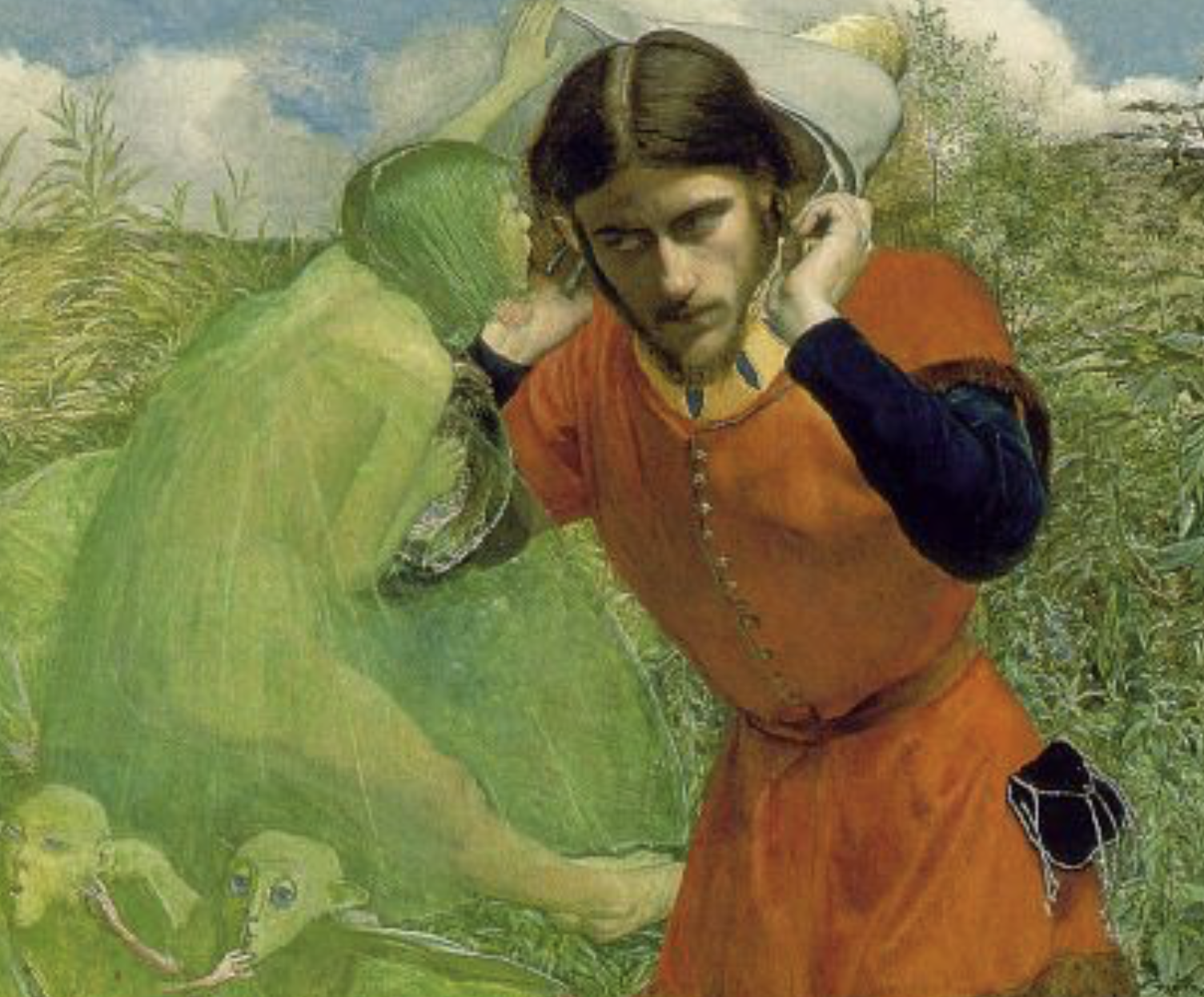
Millais is painting an episode from The Tempest, Act I, Scene II: Ferdinand, shipwrecked on Prospero’s enchanted island, hears music and tries to locate it “i’ the air or the earth?” as Ariel sings “Full fathom five thy father lies.”
This is the moment where the island begins to do what it does best: guide you without asking permission.
Ferdinand Lured by Ariel by Sir John Everett Millais
What’s happening in the painting
Ferdinand is foregrounded and intensely physical, wearing a red tunic, white hose, with one foot edging forward; yet his face is turned inward, listening. Ariel is there, but not there: a green, surreal presence tipping Ferdinand’s hat, close enough to touch him, impossible to truly see.
And then there are the wonderfully odd little creatures, green “bats” posed in a way that echoes “see no evil, hear no evil, speak no evil,” a detail that reportedly unsettled at least one early would-be buyer because it wasn’t the sweet, dainty fairy world people expected.
Millais isn’t offering a Victorian stage fairy. He’s giving you something stranger: nature itself behaving like theatre.
Why this painting matters in Pre-Raphaelite terms
This work is often pointed to as Millais’ first big attempt at the early PRB “paint what you actually see” intensity, done outdoors (plein air) at Shotover Park near Oxford.
That shows in the greenery. The plants aren’t “background.” They are presence: each clump, blade, and leaf treated as if it has rights. (This is the Pre-Raphaelite promise: the world is not a blur behind the story; the world is part of the story.)
There’s also the PRB brightness. Millais painting with heightened, saturated color, including working on a white ground to keep the whole surface lit from beneath. The red tunic against that ferocious green is basically a visual bell: you can almost hear it.
The genius choice: making the invisible visible (without ruining it)
How do you paint a spirit like Ariel, without making them into a literal cartoon fairy?
Millais’ solution is sly: he lets Ariel half disappear into the green, more like camouflage than costume. Ferdinand looks right at him, and still can’t see him. We, the viewers, can (sort of.)
It’s a perfect visual equivalent of the scene: Ferdinand is being led by something he can’t name. The island doesn’t announce itself. It insinuates.
A few things to notice when you look
The hands at Ferdinand’s ears: he’s not just hearing, he’s straining, trying to catch meaning.
That hat string detail: such a small, domestic tether in a supernatural moment, and it makes the enchantment feel practical.
The arched/circular framing: it reads like a portal, a vignette, a “peep into another world” shape. Very fairy tale, but also very controlled.
The greens: not one green, but many: acid, moss, olive, yellow green, stacked until “nature” becomes almost hallucinatory.
A tiny afterlife note (because art has one)
The finished painting was exhibited at the Royal Academy in 1850, and it has lived largely in private collections; it even became the subject of a UK temporary export bar in 2019, a reminder that these early PRB works are still treated as cultural treasures with real stakes attached.
Why I keep coming back to it
Because it’s not just “Shakespeare, illustrated.”
It’s Shakespeare filtered through that Pre-Raphaelite conviction that the world is charged, that grass and shadow can be as dramatic as a human face; that beauty can be exacting, almost severe; that the supernatural doesn’t have to glitter to be real.
Millais shows us a man lured by a musical spell.
And if you’ve ever felt art do that to you, pull you forward by the collar with something you can’t quite explain, then you already know this painting’s secret.
Exploring big feelings, brave questions, and timeless storytelling with young hearts
Younger children
Gentle, Story Only Introductions At this age, children can absolutely enjoy Hamlet inspired stories, but not the original plot in full. Look for: * Picture books that simplify the plot (or make your own!) * Versions that remove violence and death * Focus on themes like curiosity, choices, friendship, and bravery * Beautiful illustrations (which help them engage with Shakespeare’s world) Abridged Shakespeare Kids in this range can handle simplified versions of the story with gentle honesty about: * betrayal * difficult emotions * big choices * moral struggles But they still don’t need the full tragedy. Best formats: Mary Lamb & Charles Lamb adaptations Bruce Coville’s illustrated Shakespeare books Stage plays for young audiences
Tweens and Teens
The full plot, with support Middle schoolers can understand: * the ghost’s purpose * Hamlet’s indecision * family conflict * Ophelia’s emotional struggle (framed compassionately) * the idea of revenge vs. morality This age is ideal for: watching a youth-friendly production reading an abridged script discussing themes like loyalty, grief, pressure, and choices You can also begin connecting Ophelia to art, including Pre-Raphaelite interpretations. This age group loves symbolic imagery.The full play. Teens can dive into: * the original text * politics and power * mental health themes * Ophelia’s arc * existential philosophy * the tragic ending * the complexities of language At this age, discussions become richer: What does it mean to be listened to? How does society shape Ophelia’s choices? Why does Hamlet hesitate? What is “madness” in a world that demands impossible roles? This is also when Pre-Raphaelite Ophelia becomes most meaningful. Teens immediately grasp how art and literature overlap.
Introducing Hamlet
At first glance, Hamlet may seem like the last Shakespeare play you’d bring to a child. It’s a complicated saga wrapped in ghosts, grief, and betrayal, anchored by one of the most iconic tragedies ever written. And yet, beneath all that drama lies something deeply human, something children grasp with startling ease.
Hamlet is a story about feelings. It’s about families. It tumbles through confusion, love, fear, and courage. And it asks how any of us make sense of a world that has shifted beneath our feet.
Children already grapple with big emotions and big questions. They just do it in smaller settings.
You don’t have to shield them from Hamlet, however, I recommend you introduce it with care.
Here’s how to guide them gently into this extraordinary story.
Begin With the Story, Not the Language
Before diving into the play, first share Hamlet as a story.
For example: Disney’s The Lion King is loosely based on Hamlet.
The Lion King carries the echo of Hamlet, a tale of a stolen throne, a grieving son, and a ghostly father whose memory refuses to fade. Scar stands in for Claudius, the treacherous uncle who reshapes the world through violence; Simba steps into the role of the reluctant heir, driven into exile before he can understand the weight of what’s been taken from him. Even the comic relief, Timon and Pumbaa, play a lighthearted parallel to Rosencrantz and Guildenstern, companions who shift the story’s tone without altering its core.
What Disney offers, of course, is a gentler retelling: one where the prince returns, restores the world to balance, and walks into the sunrise rather than tragedy. Missing are the darker threads (Ophelia’s unraveling, the spirals of grief and madness) but the heartbeat of Shakespeare’s story remains, softened for younger eyes yet still rooted in themes of responsibility, legacy, and the courage it takes to come home.
But, back to Hamlet specifically. You can frame it in child friendly terms:
“Hamlet is a young prince who misses his dad very much. When he learns something strange and upsetting, he doesn’t know what to do. The story is about the choices he makes, the feelings he feels, and how he tries to understand what’s right.”
By doing so, you set the emotional foundation without introducing the darker complexities too quickly.
If your child is curious, tell them:
it’s a mystery,
a ghost story,
a family story,
a play full of questions.
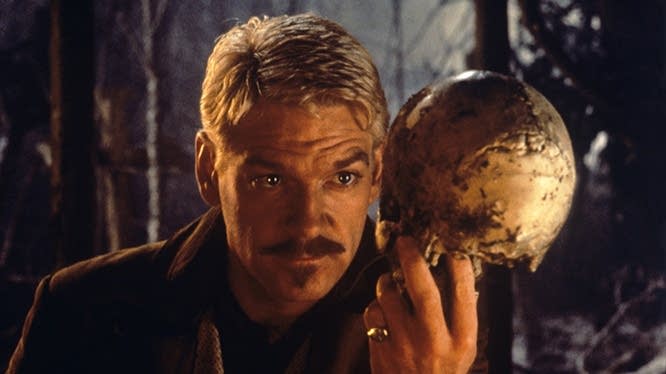
Kenneth Branagh as Hamlet
Introduce Hamlet as a Character Before a Tragedy
Children relate to characters first. Let them meet Hamlet through:
his friendship with Horatio,
his love for his father,
his confusion when things don’t make sense,
his desire to do the right thing.
Ask:
“What do you think Hamlet wants most?”
“Do you think he’s lonely?”
“Who do you trust in this story?”
Kids answer with disarming honesty.
They see Hamlet as a young person trying to navigate feelings bigger than himself.
Use the Ghost Scene to Talk About Fear & Mystery
Children often fixate on the ghost, not with terror, but fascination.
You can gently frame it like this:
“Hamlet sees the ghost of his father. In stories, ghosts often appear to share an important message or help a character understand something difficult.”
This opens the door to talk about:
fear
intuition
mysterious moments in literature
how stories use supernatural elements to explore emotions
For young kids, you can soften the scene: “Hamlet has a dreamlike moment where he thinks he sees his father.”
Let them interpret it imaginatively.
Talk About the Big Feelings
Hamlet experiences:
sadness
anger
confusion
frustration
loneliness
love
fear
bravery
This makes Hamlet an incredible emotional literacy tool.
Ask:
“Why do you think Hamlet is sad?”
“What would you do if you felt confused like that?”
“Do you think he has someone to talk to?”
“Is it hard for him to know what’s right?”
“Have you ever felt torn between two choices?”
Children are capable of remarkable emotional insight when given space.
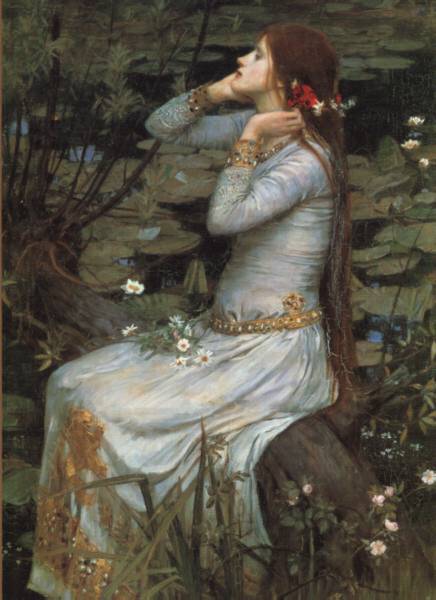
Ophelia, John William Waterhouse
Discuss Ophelia With Care
Ophelia’s story is delicate. Her sadness is deep. Her arc requires gentleness.
With younger kids:
“Ophelia is a young woman who feels very overwhelmed. She doesn’t have anyone who listens to her. The story shows how important it is to share our feelings with people who care.”
With older kids:
“Ophelia is dealing with a lot of pressure. Shakespeare shows how sadness can grow when people don’t feel supported or heard.”
Focus on:
empathy
emotional support
listening
compassion
Not the tragedy itself.
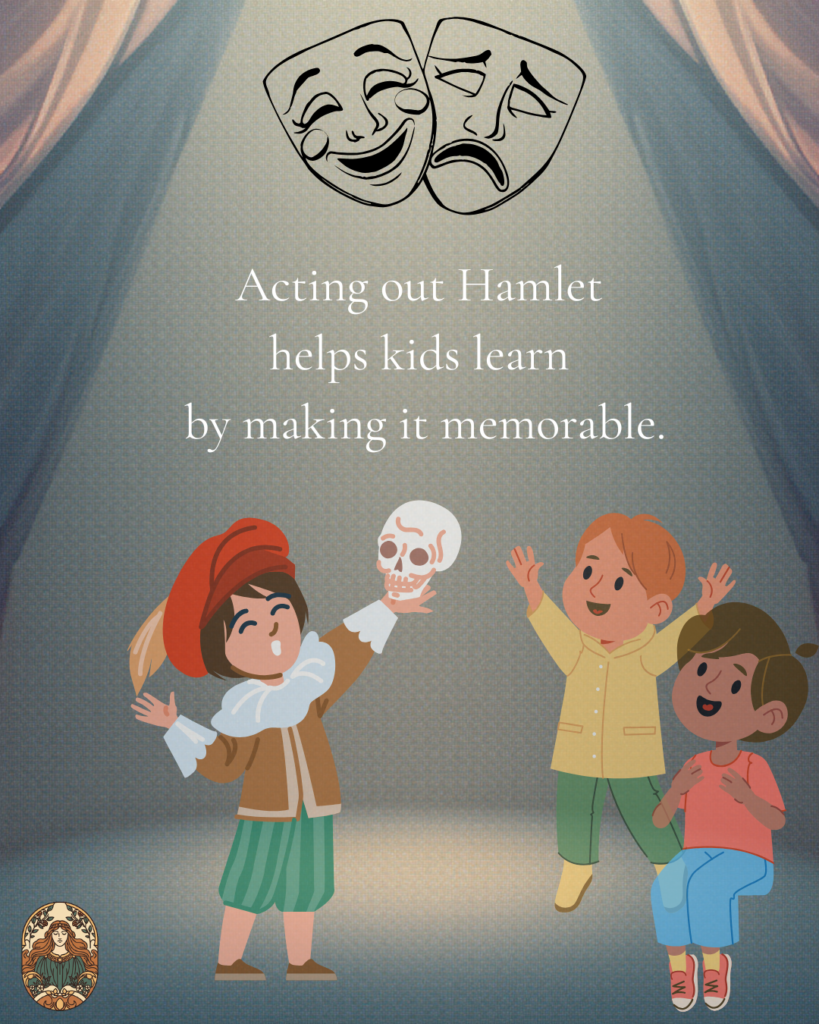
Make It Playful! Let Them Act It Out
Shakespeare was written for performance, not quiet reading.
Children learn best through play:
Act out Hamlet and Horatio meeting the ghost.
Let them pretend to be Ophelia sharing a secret with a friend.
Have a “to be or not to be” moment using silly voices.
Use puppets or toys to recreate scenes.
Stage a mini play with toy crowns, capes, or paper swords.
When kids act out Shakespeare, they often understand it instinctively.
Use Questions, Not Explanations
Kids don’t need analysis. They need curiosity.
Great questions include:
“Why do you think Hamlet hesitates?”
“Do you trust the ghost?”
“Is Claudius a good leader?”
“What makes a family feel safe?”
“Why do you think Hamlet talks to skulls?”
“Who do you think is the most loyal character?”
Let them guide the discussion.
Their answers will surprise you.
Keep the Ending Gentle
For young children, a simplified ending is kindest:
“A lot of characters make choices that lead to sad endings. Shakespeare wanted to show how important honesty, communication, and kindness are. And how secrets and revenge can cause harm.”
Older kids (10+) can handle a clearer explanation:
“Tragedies help us understand the importance of empathy, integrity, and thinking before we act.”
Focus on meaning, not mechanics.
Closing the Curtain
Introducing your kids to Hamlet isn’t about giving them a tragic story. It’s about giving them a framework for:
empathy
courage
emotional depth
moral complexity
honesty
reflection
and the beautiful messiness of being human
Shakespeare didn’t write Hamlet for scholars. He wrote him for anyone who knows what it feels like to be overwhelmed, unsure, hopeful, afraid, or brave.
Children know these feelings intimately. You might be surprised how naturally they understand him.