Author: Stephanie Chatfield

  • How to Introduce Your Kids to Hamlet

    How to Introduce Your Kids to Hamlet

    Exploring big feelings, brave questions, and timeless storytelling with young hearts

    Younger children

    Gentle, Story Only Introductions
    At this age, children can absolutely enjoy Hamlet inspired stories, but not the original plot in full. Look for:
    * Picture books that simplify the plot (or make your own!)
    * Versions that remove violence and death
    * Focus on themes like curiosity, choices, friendship, and bravery
    * Beautiful illustrations (which help them engage with Shakespeare’s world)
    Abridged Shakespeare
    Kids in this range can handle simplified versions of the story with gentle honesty about:
    * betrayal
    * difficult emotions
    * big choices
    * moral struggles
    But they still don’t need the full tragedy.
    Best formats:
    Mary Lamb & Charles Lamb adaptations
    Bruce Coville’s illustrated Shakespeare books
    Stage plays for young audiences

    Tweens and Teens

    The full plot, with support
    Middle schoolers can understand:
    * the ghost’s purpose
    * Hamlet’s indecision
    * family conflict
    * Ophelia’s emotional struggle (framed compassionately)
    * the idea of revenge vs. morality
    This age is ideal for:
    watching a youth-friendly production
    reading an abridged script
    discussing themes like loyalty, grief, pressure, and choices
    You can also begin connecting Ophelia to art, including Pre-Raphaelite interpretations. This age group loves symbolic imagery.
    The full play.
    Teens can dive into:
    * the original text
    * politics and power
    * mental health themes
    * Ophelia’s arc
    * existential philosophy
    * the tragic ending
    * the complexities of language
    At this age, discussions become richer:
    What does it mean to be listened to?
    How does society shape Ophelia’s choices?
    Why does Hamlet hesitate?
    What is “madness” in a world that demands impossible roles?
    This is also when Pre-Raphaelite Ophelia becomes most meaningful. Teens immediately grasp how art and literature overlap.

    Introducing Hamlet

    At first glance, Hamlet may seem like the last Shakespeare play you’d bring to a child. It’s a complicated saga wrapped in ghosts, grief, and betrayal, anchored by one of the most iconic tragedies ever written. And yet, beneath all that drama lies something deeply human, something children grasp with startling ease.

    Hamlet is a story about feelings.
    It’s about families.
    It tumbles through confusion, love, fear, and courage.
    And it asks how any of us make sense of a world that has shifted beneath our feet.

    Children already grapple with big emotions and big questions.
    They just do it in smaller settings.

    You don’t have to shield them from Hamlet, however, I recommend you introduce it with care.

    Here’s how to guide them gently into this extraordinary story.

    Begin With the Story, Not the Language

    Before diving into the play, first share Hamlet as a story.

    For example: Disney’s The Lion King is loosely based on Hamlet.

    The Lion King carries the echo of Hamlet, a tale of a stolen throne, a grieving son, and a ghostly father whose memory refuses to fade. Scar stands in for Claudius, the treacherous uncle who reshapes the world through violence; Simba steps into the role of the reluctant heir, driven into exile before he can understand the weight of what’s been taken from him. Even the comic relief, Timon and Pumbaa, play a lighthearted parallel to Rosencrantz and Guildenstern, companions who shift the story’s tone without altering its core.

    What Disney offers, of course, is a gentler retelling: one where the prince returns, restores the world to balance, and walks into the sunrise rather than tragedy. Missing are the darker threads (Ophelia’s unraveling, the spirals of grief and madness) but the heartbeat of Shakespeare’s story remains, softened for younger eyes yet still rooted in themes of responsibility, legacy, and the courage it takes to come home.

    But, back to Hamlet specifically. You can frame it in child friendly terms:

    “Hamlet is a young prince who misses his dad very much. When he learns something strange and upsetting, he doesn’t know what to do. The story is about the choices he makes, the feelings he feels, and how he tries to understand what’s right.”

    By doing so, you set the emotional foundation without introducing the darker complexities too quickly.

    If your child is curious, tell them:

    • it’s a mystery,
    • a ghost story,
    • a family story,
    • a play full of questions.
    Kenneth Branagh as Hamlet

    Introduce Hamlet as a Character Before a Tragedy

    Children relate to characters first.
    Let them meet Hamlet through:

    • his friendship with Horatio,
    • his love for his father,
    • his confusion when things don’t make sense,
    • his desire to do the right thing.

    Ask:

    • “What do you think Hamlet wants most?”
    • “Do you think he’s lonely?”
    • “Who do you trust in this story?”

    Kids answer with disarming honesty.

    They see Hamlet as a young person trying to navigate feelings bigger than himself.

    Use the Ghost Scene to Talk About Fear & Mystery

    Children often fixate on the ghost, not with terror, but fascination.

    You can gently frame it like this:

    “Hamlet sees the ghost of his father. In stories, ghosts often appear to share an important message or help a character understand something difficult.”

    This opens the door to talk about:

    • fear
    • intuition
    • mysterious moments in literature
    • how stories use supernatural elements to explore emotions

    For young kids, you can soften the scene:
    “Hamlet has a dreamlike moment where he thinks he sees his father.”

    Let them interpret it imaginatively.

    Talk About the Big Feelings

    Hamlet experiences:

    • sadness
    • anger
    • confusion
    • frustration
    • loneliness
    • love
    • fear
    • bravery

    This makes Hamlet an incredible emotional literacy tool.

    Ask:

    • “Why do you think Hamlet is sad?”
    • “What would you do if you felt confused like that?”
    • “Do you think he has someone to talk to?”
    • “Is it hard for him to know what’s right?”
    • “Have you ever felt torn between two choices?”

    Children are capable of remarkable emotional insight when given space.

    waterhouse ophelia
    Ophelia, John William Waterhouse

    Discuss Ophelia With Care

    Ophelia’s story is delicate.
    Her sadness is deep.
    Her arc requires gentleness.

    With younger kids:

    Ophelia is a young woman who feels very overwhelmed. She doesn’t have anyone who listens to her. The story shows how important it is to share our feelings with people who care.”

    With older kids:

    Ophelia is dealing with a lot of pressure. Shakespeare shows how sadness can grow when people don’t feel supported or heard.”

    Focus on:

    • empathy
    • emotional support
    • listening
    • compassion

    Not the tragedy itself.

    Make It Playful! Let Them Act It Out

    Shakespeare was written for performance, not quiet reading.

    Children learn best through play:

    • Act out Hamlet and Horatio meeting the ghost.
    • Let them pretend to be Ophelia sharing a secret with a friend.
    • Have a “to be or not to be” moment using silly voices.
    • Use puppets or toys to recreate scenes.
    • Stage a mini play with toy crowns, capes, or paper swords.

    When kids act out Shakespeare, they often understand it instinctively.

    Use Questions, Not Explanations

    Kids don’t need analysis. They need curiosity.

    Great questions include:

    • “Why do you think Hamlet hesitates?”
    • “Do you trust the ghost?”
    • “Is Claudius a good leader?”
    • “What makes a family feel safe?”
    • “Why do you think Hamlet talks to skulls?”
    • “Who do you think is the most loyal character?”

    Let them guide the discussion.

    Their answers will surprise you.

    Keep the Ending Gentle

    For young children, a simplified ending is kindest:

    “A lot of characters make choices that lead to sad endings. Shakespeare wanted to show how important honesty, communication, and kindness are. And how secrets and revenge can cause harm.”

    Older kids (10+) can handle a clearer explanation:

    “Tragedies help us understand the importance of empathy, integrity, and thinking before we act.”

    Focus on meaning, not mechanics.

    Closing the Curtain

    Introducing your kids to Hamlet isn’t about giving them a tragic story. It’s about giving them a framework for:

    • empathy
    • courage
    • emotional depth
    • moral complexity
    • honesty
    • reflection
    • and the beautiful messiness of being human

    Shakespeare didn’t write Hamlet for scholars.
    He wrote him for anyone who knows what it feels like to be overwhelmed, unsure, hopeful, afraid, or brave.

    Children know these feelings intimately.
    You might be surprised how naturally they understand him.

    Kenneth Brannagh as Hamlet

  • What the Pre-Raphaelites Teach Us About Beauty Today

    What the Pre-Raphaelites Teach Us About Beauty Today

    Beauty can be a slippery thing. It shifts as we age, evolves as the world changes, and often hides beneath layers of expectation we never meant to carry.

    Yet more than 170 years ago, a small group of young artists barely out of their teens, glimpsed this struggle. In 1848, the Pre-Raphaelite Brotherhood broke away from the conventions of Victorian art and turned toward a different vision: one steeped in honesty, emotion, and fearless beauty. And somehow, their lessons still feel startlingly modern.

    Beauty Begins With Looking Closely

    The Pre-Raphaelites believed that truth lived in the details. A single curl of hair, the glint of light on a glass vase, the veins of an ivy leaf.

    Isabella and the Pot of Basil
    Isabella and the Pot of Basil, William Holman Hunt

    In a world that encourages us to scroll, skim, and rush, their work whispers a gentle rebellion: slow down.

    Beauty can reveal itself when you take the time to actually look.

    This isn’t just about art. It’s about the small joys we tuck into our days and the parts of ourselves we forget to notice. The Pre-Raphaelites remind us that beauty waits quietly and patiently for us to witness it.

    Mariana, Sir John Everett Millais
    Mariana, Sir John Everett Millais

    Beauty Is Not a Synonym for Perfection

    Victorian ideals seem to have demanded a tight corset on everything, from bodies to behaviors and emotions. The Pre-Raphaelites loosened the laces. They painted women who looked real: weary, dreamy, fierce, wounded, complicated. Instead of polished elegance, they offered depth, interiority, and emotional truth.

    In an era obsessed with filters and symmetry, their work suggests a radical counterpoint: beauty expands when perfection stops being the goal.

    Freckles, softness, expression, sorrow, thoughtfulness… we recognize ourselves in these things more than in flawless surfaces.

    Ophelia by Arthur Hughes
    Ophelia, Arthur Hughes

    Beauty Is Story, Not Just Surface

    Most Pre-Raphaelite paintings are a narrative. Ophelia doesn’t simply float among flowers; she carries centuries of grief and interpretation with her. Mariana doesn’t merely lean in a chair; she embodies waiting, longing, and resilience. Elizabeth Siddal isn’t just a model. She is a poet, an artist, a woman whose inner life shaped the very movement that immortalized her face.

    Their art reminds us that beauty is not an aesthetic metric but a lived story.

    Even our own reflection becomes richer when we remember the layers behind it, the experiences we’ve survived, the passions that shape us, the people we’ve loved, the creativity that pulls us forward.

    la ghirlandata
    La Ghirlandata, Dante Gabriel Rossetti

    Beauty Is a Conversation With the Past

    The Pre-Raphaelites reached back to medieval tapestries, Arthurian legends, Shakespearean tragedies, and Renaissance texts. They found beauty not by chasing novelty but by entering into dialogue with history. In doing so, they built a bridge between eras, proof that beauty persists across centuries because it speaks to something unchanging in us.

    Today, when trends rise and fall with dizzying speed, their work encourages a deeper kind of grounding. Beauty endures when we root it in something lasting, when it connects us to more than the moment in front of us Whether that’s art, literature, nature, spirituality, or personal history, the result is the same: a beauty that feels lived in rather than disposable.

    Defense of Guenevere
    The Defense of Guenevere, Jane Morris

    We Create Beauty, We Don’t Simply Receive It

    The Brotherhood didn’t wait to get permission from the artistic establishment, they feverishly strove to champion their message. They met frequently, worked hard, and debated fiercely to hone their ideas. No doubt they made mistakes, but always tried again. And they chose, deliberately, to create something that felt true rather than something that felt safe.

    This is a powerful reminder today, where we see beauty presented as something to acquire through products, diets, or trends, rather than something to shape with our own hands.

    The Pre-Raphaelites teach us that creativity is beauty. Curiosity is beauty. Craft is beauty. The act of making art, thought, or meaning is itself a form of self representation more honest than any mirror.

    Dante Gabriel Rossetti   Proserpine   Google Art Project
    Proserpine, Dante Gabriel Rossetti

    Beauty Holds Both Light and Shadow

    Pre-Raphaelite canvases glow with saturated color, luminous skin, and jewel-like natural details. Yet woven through that radiance is sorrow: Ophelia’s impending death, Proserpine’s captivity, the haunted longing of Dante Gabriel Rossetti’s later work. Their beauty is never naive; it is beauty with full knowledge of darkness and melancholy.

    Lachrymae, Lord Frederic Leighton

    This feels especially relevant today, when many of us are learning to hold joy and grief simultaneously. The Pre-Raphaelites show us that beauty can contain sadness without collapsing. It can reflect the complexity of real life and still shimmer.

    Beauty Is an Act of Paying Attention to Yourself

    Pre-Raphaelite painter and poet Elizabeth Siddal once wrote, “I care not for my lady’s soul / Though I worship before her smile.” She was pointing to a gaze that never moves beyond the surface; a lover who praises beauty yet ignores the woman’s mind, heart, and inner life. In The Lust of the Eyes, Siddal urges us to redirect that close, reverent attention inward: toward the soft places we neglect, the thoughts we quiet, the dreams we delay, the parts of ourselves that deserve to be seen with the same care we give to great works of art. To live with beauty today means to acknowledge yourself as a worthy subject.

    The Lust of the Eyes
    Elizabeth Siddal

    I care not for my Lady’s soul
    Though I worship before her smile;
    I care not where be my Lady’s goal
    When her beauty shall lose its wile.
    Low sit I down at my Lady’s feet
    Gazing through her wild eyes
    Smiling to think how my love will fleet
    When their starlike beauty dies.
    I care not if my Lady pray
    To our Father which is in Heaven
    But for joy my heart’s quick pulses play
    For to me her love is given.
    Then who shall close my Lady’s eyes
    And who shall fold her hands?
    Will any hearken if she cries
    Up to the unknown lands?
    Elizabeth Siddal
    Painting of Elizabeth Siddal by Dante Gabriel Rossetti

    Pre-Raphaelite paintings are not just relics of Victorian art; they are invitations.

    Invitations to look closely.

    To honor complexity.

    Celebrate individuality.

    Resist the flattening pace of modern life.

    Allow beauty to be something lived rather than pursued.

    More than a century later, they still teach us this:

    Beauty is not what you perfect. Beauty is what you notice, what you create, and what you dare to see. Both in the world and within yourself.

  • Color Palette Inspired by Veronica Veronese

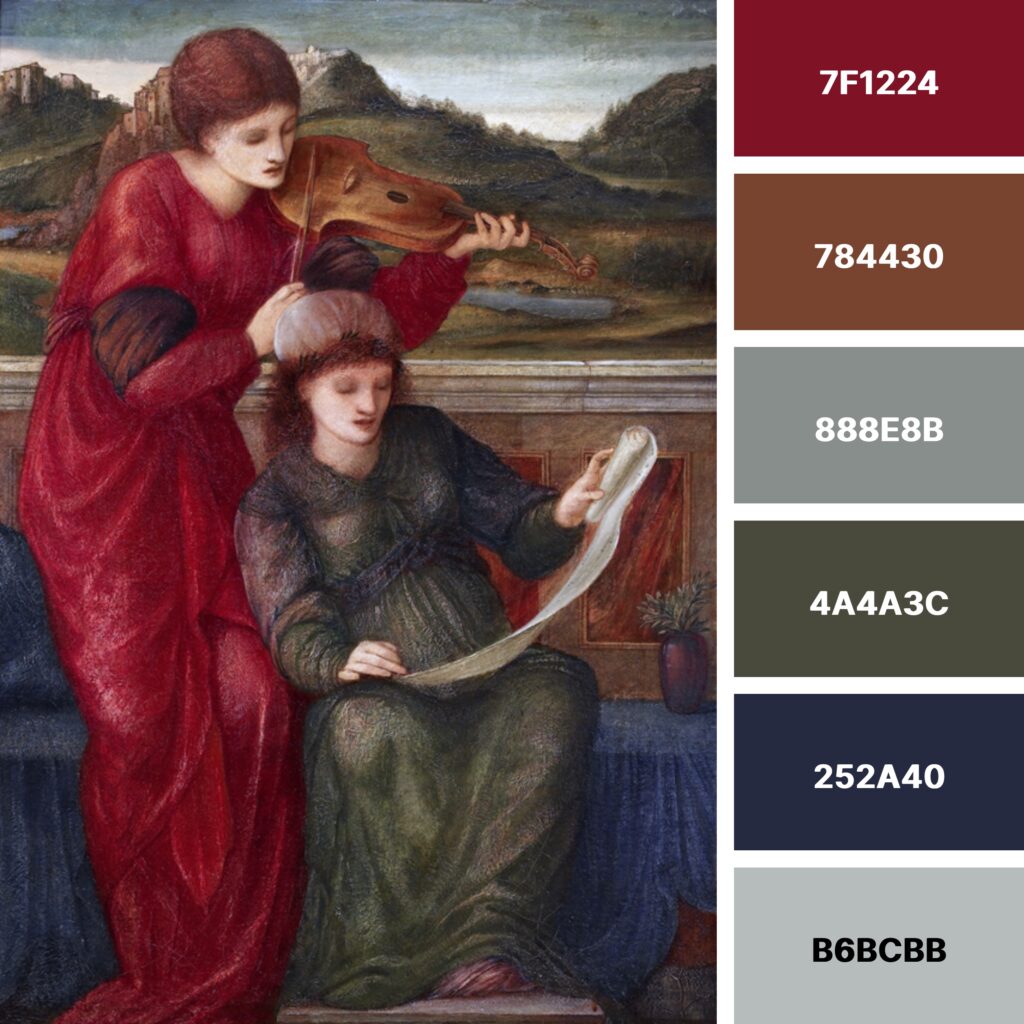
    Color Palette Inspired by Veronica Veronese

    Here’s a color palette inspired by Dante Gabriel Rossetti’s Veronica Veronese. It’s a stunning work filled with rich greens, warm golds, and deep earthy tones. Feel free to use this palette for your own designs. It’s perfect for digital graphics, mood boards, or anything that could use a touch of Pre-Raphaelite color.

    Veronica Veronese Color Palette
    Step inside the burnished, dream-green world of Rossetti’s Veronica Veronese with this lush color palette, drawn directly from the painting’s velvet shadows and golden light

    Veronica Veronese described by Rossetti:

    Suddenly leaning forward, the Lady Veronica rapidly wrote the first notes on the virgin page. Then she took the bow of the violin to make her dream reality; but before commencing to play the instrument hanging from her hand, she remained quiet a few moments, listening to the inspiring bird, while her left hand strayed over the strings searching for the supreme melody, still elusive. It was the marriage of the voices of nature and the soul — the dawn of a mystic creation.
    – Dante Gabriel Rossetti

    The description above is using these colors from the palette: Background: EEDBA5, Quotation marks: 793705, Left Border: 1F2604 Text: 1F2604

    Alexa Wilding is the model in Veronica Veronese, and she appears throughout many of Rossetti’s later paintings. For a wonderfully engaging look at her life as a Pre-Raphaelite muse, Kirsty Stonell Walker’s novel A Curl of Copper and Pearl offers a vivid and entertaining reimagining of Alexa’s world.

    Alexa Wilding
    Alexa Wilding, Dante Gabriel Rossetti
  • How to Introduce Your Children to Victorian Art

    How to Introduce Your Children to Victorian Art

    Introducing kids to Victorian art isn’t about lectures or timelines; it’s about opening a window into a world where stories glow in color, details brim with meaning, and imagination runs gloriously wild.

    Ultimately, Victorian art, especially the works of the Pre-Raphaelites, offers exactly the kind of visual richness children instinctively respond to. It’s theatrical and emotional. Art of the 19th Century is filled with hidden objects, dramatic gestures, fairy tale settings, animals, flowers, myths, and expressive faces. In other words: it’s perfect for kids.

    Here are a few ways to share the magic with them.

    Start With the Stories

    Miranda by John William Waterhouse is based on Shakespeare’s play The Tempest.

    Victorian art is steeped in storytelling. There’s no need to begin with technical art terms. Start with the narrative.

    Ask questions like:

    • “What do you think is happening here?”
    • “Who do you think this person is?”
    • “What do you see first?”
    • “What would happen next if this painting were a book?”

    Works like Millais’ Ophelia, Rossetti’s The Day-Dream, Holman Hunt’s The Lady of Shalott, and Waterhouse’s The Soul of the Rose are just a few examples of works that instantly invite storytelling. Children naturally fill in the gaps.

    Victorian painters adored literature and tales of fairy tales, medieval romances, Shakespeare, Tennyson. Children adore stories, too. This is your bridge.

    The Day-Dream, Dante Gabriel Rossetti

    Notice the Details (Victorian Artists Loved Them)

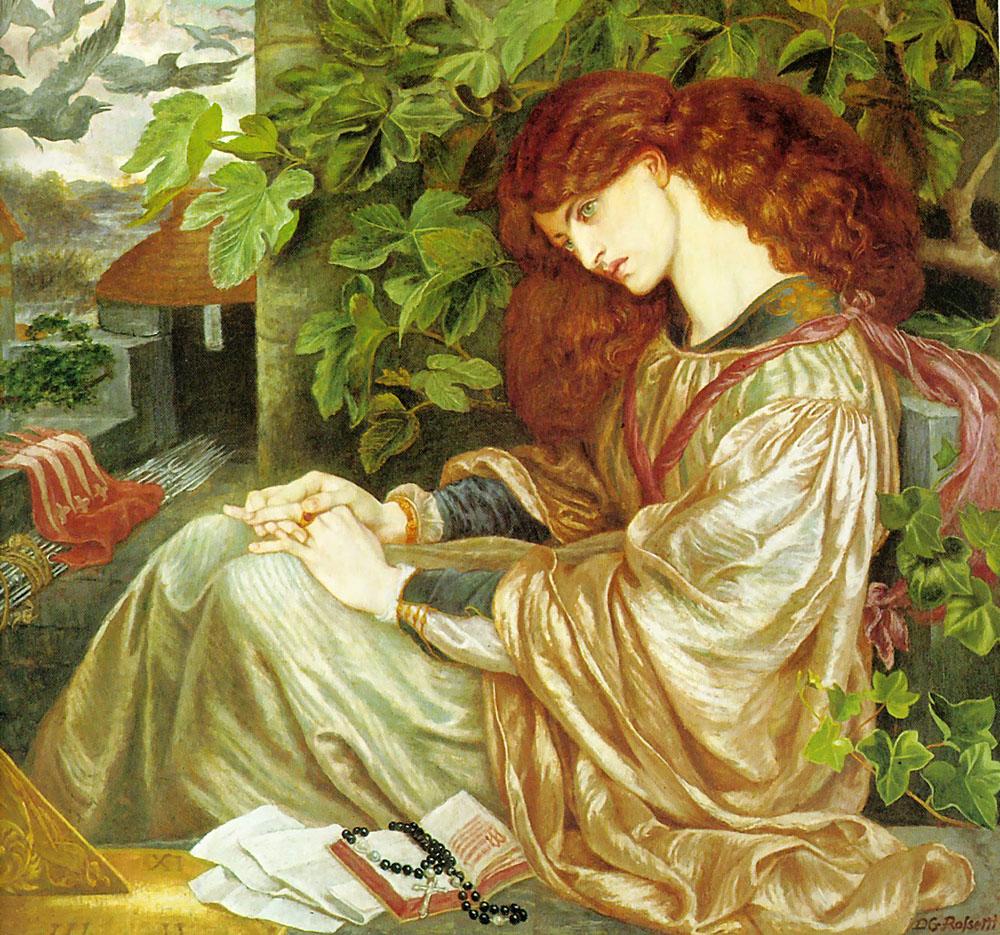
    Pia de Tolomei, Rossetti
    Pia de Tolomei, Dante Gabriel Rossetti (1868).

    Victorian artists painted like detectives: every blossom, book, feather, gesture, and ray of light meant something.

    Encourage your kids to:

    • Describe any jewelry or interesting items, such as furniture
    • Spot animals, insects, or flowers
    • Count objects
    • Search for symbols
    • Notice clothing or expression changes

    Turn a painting into a treasure hunt. Suddenly, Victorian art becomes interactive rather than dusty.

    Connect Art to Nature

    The Blind Girl, Millais
    The Blind Girl, Sir John Everett Millais

    The Victorians, especially the Pre-Raphaelites, were obsessed with nature. They painted outdoors, studied plants, and described leaves and flowers with botanical accuracy.

    Bring art into the physical world:

    • Go on a nature walk and find leaves that match the paintings
    • Bring a book of flowers and identify what’s in Ophelia’s hands
    • Compare real petals to Waterhouse’s roses
    • Sketch outside like Millais or Rossetti
    • Collect and press flowers in a book

    Art becomes less like a museum label and more like a living, breathing world they can step into.

    Encourage Them to Make Their Own Victorian Inspired Art

    Littlefootpage 1
    The Little Foot Page, Eleanor Fortescue Brickdale

    Children should experience the art in their hands, not just their eyes.

    Ideas:

    • Paint or draw using muted Victorian palettes (moss green, rose, gold, sky blue)
    • Create a portrait of a favorite toy “Victorian style”
    • Illustrate their own myth or fairy tale
    • Make a paper crown for a Pre-Raphaelite hero or heroine
    • Try watercolors to capture “dreamy” soft light
    • Copy a tiny corner of a larger painting

    Art becomes play… and play becomes understanding.

    Use Children’s Books and Kid-Friendly Resources

    An iconic Victorian book illustration: The White Rabbit, John Tenniel, Alice in Wonderland

    Victorian art pairs beautifully with:

    • Illustrated storybooks
    • Mythology or fairy-tale collections
    • Short bios of artists
    • Kid-friendly museum guides
    • Graphic novel versions of classics

    If your child enjoys Greek myths or fairy tales, Victorian art’s interpretations of those stories will feel like natural extensions.

    Visit a Museum (or Create a “Home Museum”)

    Children thrive when art is an experience

    At a museum:

    • Visit one or two Victorian paintings, not twenty
    • Spend time with a single artwork and talk about it
    • Encourage them to find “their favorite detail”
    • Bring a notebook and let them sketch quietly

    At home:

    • Print a few paintings and hang them at kid-eye level. Or use postcards; there are so many gorgeous postcards of paintings available online.
    • Make a rotating “gallery wall”
    • Have a weekly “choose a painting” ritual
    • Use the prints as inspiration for bedtime stories. You can take turns making up your own stories about paintings, no doubt your children can thrill you with their own imaginative tales!

    Victorian art becomes familiar, comforting, and part of the daily fabric of life.

    Talk About Feelings, Not Facts

    The Vale of Rest
    The Vale of Rest, Sir John Everett Millais

    Children don’t need dates or movements, that can come later, if they want. Right now, they need connection.

    Ask:

    • “How does this picture make you feel?”
    • “What do you think she’s thinking?”
    • “Does this scene look calm? Sad? Exciting?”
    • “Which character would you be?”

    Victorian artists loved depicting emotions such as longing, courage, frustration, hope, curiosity, enchantment. Children instinctively read these expressions and respond with honesty.

    Let the Art Be a Conversation Starter

    Victorian art opens gentle doors to big topics:

    • Why do people tell stories?
    • Why do artists make things beautiful?
    • What makes a hero?
    • What is imagination?
    • Why do we look at art at all?

    Art is a safe, effective way of talking about life. Go for it!

    Introducing your children to Victorian art isn’t about building mini art historians (unless that’s what they want!), it’s about giving them a set of eyes that notice beauty, pattern, emotion, and story. The Victorians believed art should enrich the spirit, awaken empathy, and spark the imagination and that’s a perfect recipe to capture your child’s wonder!

    Midsummer Eve, Edward Robert Hughes