Some reviews are harsh, but Charles Dickens’s review of Millais’s Christ in the House of His Parents took criticism to another level.
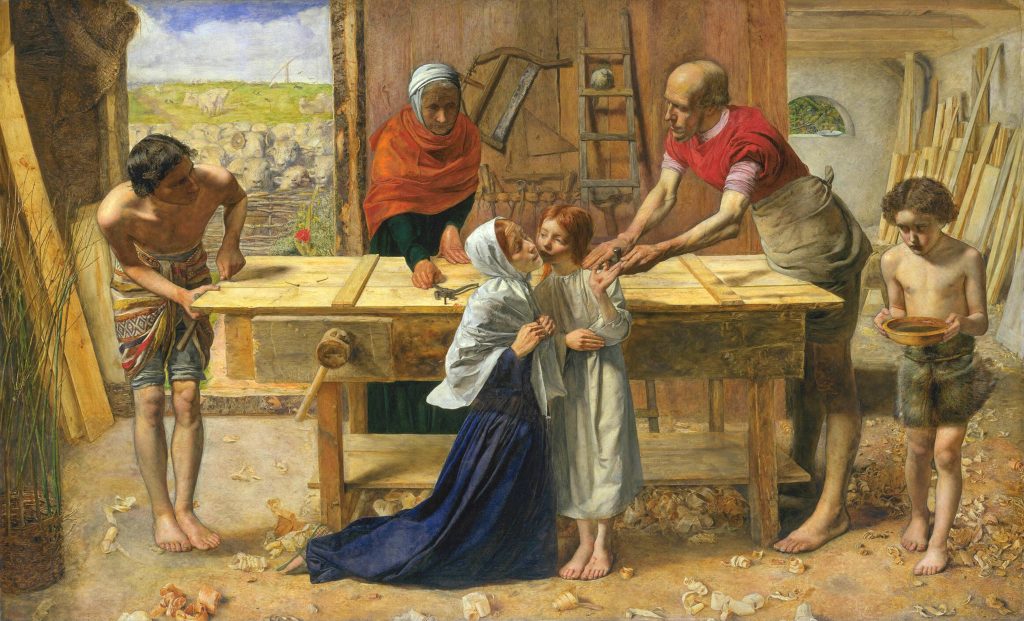
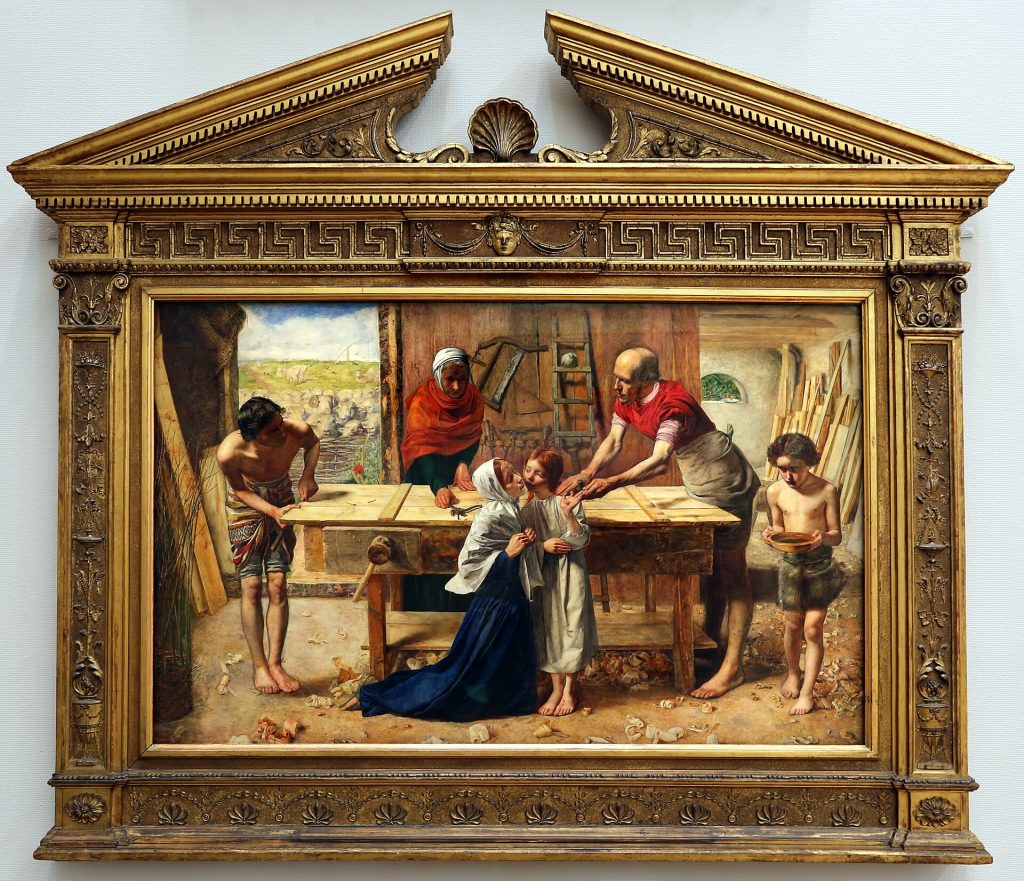
In 1850, John Everett Millais, then just twenty, exhibited his painting Christ in the House of His Parents at the Royal Academy. Instead of showing the Holy Family in an idealized biblical scene, he placed them in Joseph’s busy, dusty carpenter’s shop, surrounded by wood, tools, shavings, and people painted with careful attention to detail.
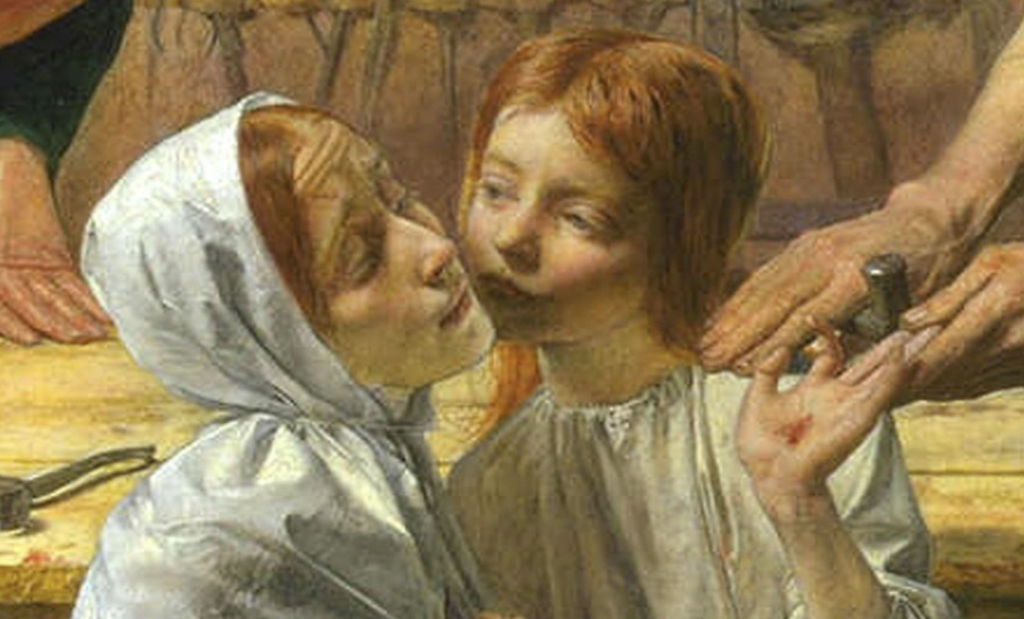
In the painting, the young Christ hurts his hand on a nail, and blood drips toward his foot, hinting at the wounds he will later receive on the Cross. Mary cares for him, Joseph checks the injury, and young John the Baptist brings water. Outside, sheep gather behind a fence, symbolizing the future Christian flock.
The painting is full of symbols, using everyday items like a nail, a bowl of water, a wooden door, a ladder, a dove, a scared child, and workers’ hands.
Today, Christ in the House of His Parents is on display at Tate Britain and is seen as a key early Pre-Raphaelite work. But in 1850, its realistic style shocked many people.
Dickens responded with fierce criticism.
The shock of an ordinary Holy Family
Victorian viewers expected religious art to show the Holy Family as beautiful, dignified, and distant. Millais took a bold step by showing them as part of an ordinary working family.
The shop is not pretty. Joseph’s arms show signs of hard work. Their fingernails are dirty, and wood shavings cover the floor. The people in the painting are grounded in real life, not set apart from it.
This was Millais’s intention. By mixing careful observation with Christian symbols, he showed that the sacred can come from everyday life, not just from distant ideals. The painting encourages viewers to see holiness in work, vulnerability, family care, and even pain.
To Dickens, this approach did not feel like spiritual truth. Instead, he saw it as disrespectful.
Dickens’s response, called “Old Lamps for New Ones,” appeared in Household Words on June 15, 1850. He admired Raphael and took the term “Pre-Raphaelite” as a criticism of Raphael’s tradition. His dislike of the Oxford Movement, which was linked to early Pre-Raphaelitism, also shaped his view. He believed there was more than one unattractive painting involved and thought this art was leading culture, religion, and art in the wrong direction.
When criticism becomes spectacle
Dickens didn’t just criticize the painting’s style, symbolism, or technique. He also attacked how the people looked, especially the young Christ and the Virgin Mary.
He warned readers who hadn’t seen the painting to expect something “mean, odious, repulsive, and revolting.” He insulted the figures, describing their bodies and faces as ugly.
Reading this is uncomfortable, partly because it’s so unexpected. Readers of Dickens know his writing usually inspired sympathy for people society ignored. In his novels, his detailed descriptions revealed injustice and gave a voice to the neglected. Here, though, his skill with detail turned into a tool for attack.
His words were lively, memorable, and fierce, but they were also so dramatic that they drew attention away from the painting itself.
This is the risk when contempt is presented as criticism. It draws attention but makes thoughtful discussion difficult.
Dickens did raise important questions, though: Should sacred art make its subjects look ideal? Can realistic details fit with spiritual themes? Why did some people find it offensive to see the Holy Family as working people? What beliefs about class, beauty, cleanliness, and holiness were being questioned?
These questions could have started a thoughtful discussion about the painting.
But ridicule ended that possibility.
Fame is not the same as infallibility.
By 1850, Dickens was no longer just a reviewer. He was one of Britain’s most famous writers, with a strong moral voice, a large audience, and his own platform.
His fame made his opinions more influential, but not always right.
This episode is still interesting because Dickens was smart and often showed empathy. He cared about social issues and moral questions, but sometimes his certainty, biases, and desire to perform made him unfair.
We often believe that authority settles a debate. When a famous critic or expert shares an opinion, their confidence can seem like proof, even without real evidence.
But sounding certain is not the same as being right.
History is full of confident judgments that later seem narrow, rushed, or even silly. Prestige does not protect a critic from mistakes; sometimes it just gives those mistakes a bigger stage.
Did Dickens regret it?
The answer is more complex than just yes or no.
Five years after his review, Dickens sent Millais a copy of Household Words and referred to their past disagreements. He still did not like that painting, but he made it clear he respected Millais’s growing talent. They later became good friends.
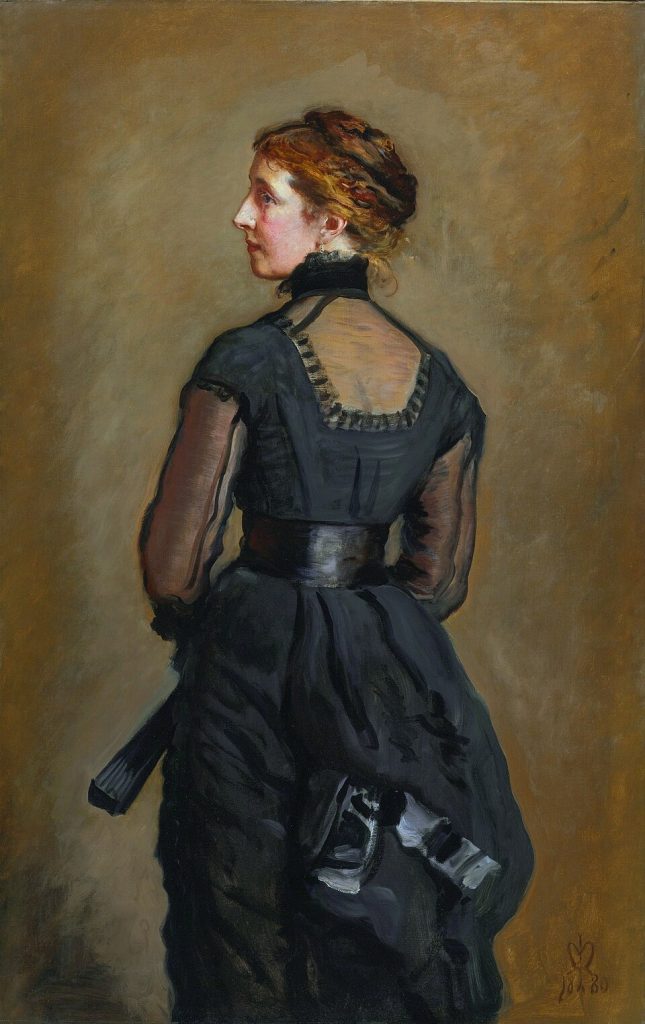
In 1903 Kate Perugini, who was an artist herself, stated that her father’s reaction had been a “very harsh and hasty criticism” and said that she had “reason to believe he regretted having published” it.
Regret does not mean we have to change every opinion we once held. Sometimes we regret how we expressed our judgment, whether it was rushed, hurtful, showy, or failed to consider another person’s humanity.
Dickens may never have come to like Christ in the House of His Parents. Still, he could have realized that disliking a painting does not mean he had to insult the artist or those in the painting.
What time did to the argument
Dickens is still relevant today. People keep reading his work because it is lively, complex, funny, and poignant.
Time has not shown that all criticism of the Pre-Raphaelites was wrong. Their art can be sentimental, overdone, troubling, beautiful, uneven, and amazing, all at the same time. Honest criticism helps us notice these details.
But over time, the relationship between Dickens’s review and Millais’s painting has shifted.
The review is remembered mostly because Dickens wrote it and its harshness is now part of the painting’s story. The painting lasts because it still draws viewers in. Its symbols are still there. Its realism still surprises. And its tenderness still shows through the sawdust.
Dickens’s harsh review was just one part of the painting’s story, not the final word.
This may be time’s most helpful role as a critic. Over time, it separates helpful insights from insults that only made a splash. Good criticism can stay important even as tastes change. Dramatic contempt often reveals more about the critic than about the work itself.
Today, our culture can create an “Old Lamps for New Ones” moment almost every few minutes.
A first impression quickly turns into a final judgment, and reactions become performances. Online, the most shocking phrase spreads faster than the most accurate one. People respond to short clips, rally supporters, and find that drama gets more attention than curiosity for the truth.
The technology may be new, but the temptation is not.
What Charles Dickens’s Review of Millais Teaches Us Today
Examine thoughtfully before reacting.
Public opinion often distracts from the real issue. Before accepting someone else’s view, look at what is actually there. We should examine it closely; read the original words and consider the whole work, not just its reputation.
Know the difference between criticism and humiliation.
Criticism looks at what works, what does not, what shapes the work, and what results from it. Humiliation attacks how someone looks, their character, intelligence, motives, or sense of belonging. Criticism helps us understand; humiliation just draws a crowd.
Don’t mistake prominence for proof.
A big audience can make a claim louder, but that does not make it true. The speaker’s reputation matters, but we still need to check the facts ourselves.
Be open to changing your mind.
We all make mistakes when we interpret things. Our views on art and each other come from our own experiences, loyalties, fears, tastes, and expectations. Being humble about our ideas is not weakness, it means knowing that even strong opinions can be incomplete.
Remember that time will judge what we say.
A snappy insult might get attention now, but the work itself, the evidence, and the record last much longer.
The work remains
The point is not just that critics are often wrong, that would be too simple. The real lesson is that we all sometimes mistake forceful words for clarity.
Dickens viewed Millais’s painting through his own artistic loyalties, religious worries, and ideas about beauty. Instead of separating these feelings, he turned them into criticism. His skill made the review memorable, but not generous.
Millais’s painting did not need Dickens’s approval to last.
The carpenter’s shop is still there. The worried family remains. The wound, the water, the wood, and the waiting sheep remain. People can still stand before the painting today and decide for themselves what they see.
The quiet strength of focusing on meaningful work, instead of harsh criticism, is that the work can keep speaking long after the critic is gone.
Further reading
- Charles Dickens, “Old Lamps for New Ones”, Household Words, June 15, 1850.
- Dickens Journals Online’s contextual notes on the review, Dickens’s later correspondence with Millais, and Kate Perugini’s recollection.
- Tate, Christ in the House of His Parents (‘The Carpenter’s Shop’), 1849–50.
- Tate, “Why Were the Pre-Raphaelites So Shocking?”.