
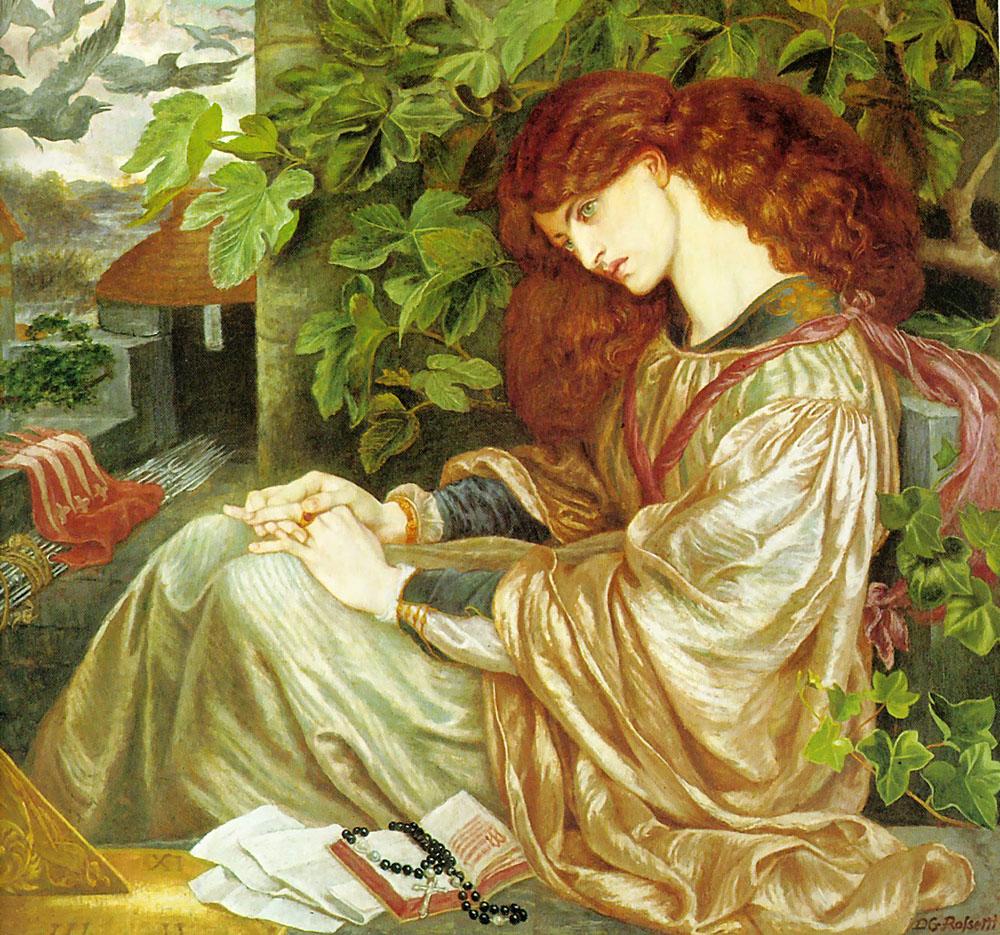
In 1868, Dante Gabriel Rossetti painted Jane Morris as La Pia de’ Tolomei, a figure drawn from Dante Alighieri’s Purgatorio. Pia appears in Canto V, where she is encountered not in the blaze of Hell, but in that more chilling middle country where souls wait for release.
Her story is brief in Dante, and therefore merciless. Her plea is simple:
“Please remember me, who am La Pia.
Siena made me, in Maremma I was undone.
He knows how, the one who, to marry me,
first gave the ring that held his stone.”
With quiet sorrow, she points to her wedding ring, which allows us to understand that the hand that placed it is also the hand that ended her life.
Her husband, Nello, wanted another marriage, one with a countess, and so he removed Pia the way a man removes a troublesome object: by shutting it away.
Pietra Castle becomes the site of her imprisonment, isolating her from the world. That is the scene Rossetti gives us: Jane Morris (as Pia) seated in that high, enclosed place, the air heavy with leaves and time. In the distance rooks traverse the sky like black annotations, marginalia added to a story whose ending is already fixed.
What is most unsettling is how little drama Rossetti allows her. Pia does not claw at the stone. She does not beg. She sits with the calm of someone forced into stillness so long it has begun to resemble her nature.
Her face is turned inward; her fingers return to the wedding ring, not lovingly, not even angrily, but with the dazed attention of someone touching the evidence of their own captivity.
Strip away the medieval castle and the Dantean tragedy and you find the story’s core: a woman sealed inside a life arranged by cruelty instead of love.
Like the Lady of Shalott, or Mariana in her moated house, Pia is not simply lonely, she has been removed from the human current. She exists apart. The world continues without her, and that, more than death, is the punishment.
And so her simple request matters. Not grand justice. Not revenge. Only this:
“Remember me.”
To be remembered is to be known. It is to insist, quietly, stubbornly, I was here. I felt. I mattered.
Pia asks for remembrance because forgetting is the final violence.
Being erased is worse than being wronged.
That is why La Pia de’ Tolomei still catches at the throat. It does not have to be about marriage alone. People are exiled in other ways. By duty, by grief, by the slow, reasonable compromises that become a prison before you notice the door has disappeared.
The most dangerous confinements are the ones you decorate, the ones you call “fine.” What you learn to endure until endurance begins to feel like identity.
Pia languished.
We do not have to.
I think that if the Pia of this painting could speak to us, she might say something like this:
“Go and live so authentically, and so fully that you cannot be lost to yourself.”
For more beauty, color, and curiosity, subscribe to the Guggums newsletter