Search results for: “fashion details/page/4/Pre-Raphaelite: Not a look, a movement”

  • A Pre-Raphaelite Look at Hitchcock’s Vertigo

    A Pre-Raphaelite Look at Hitchcock’s Vertigo

    by Stephanie Chatfield

    Warning: This post contains spoilers.
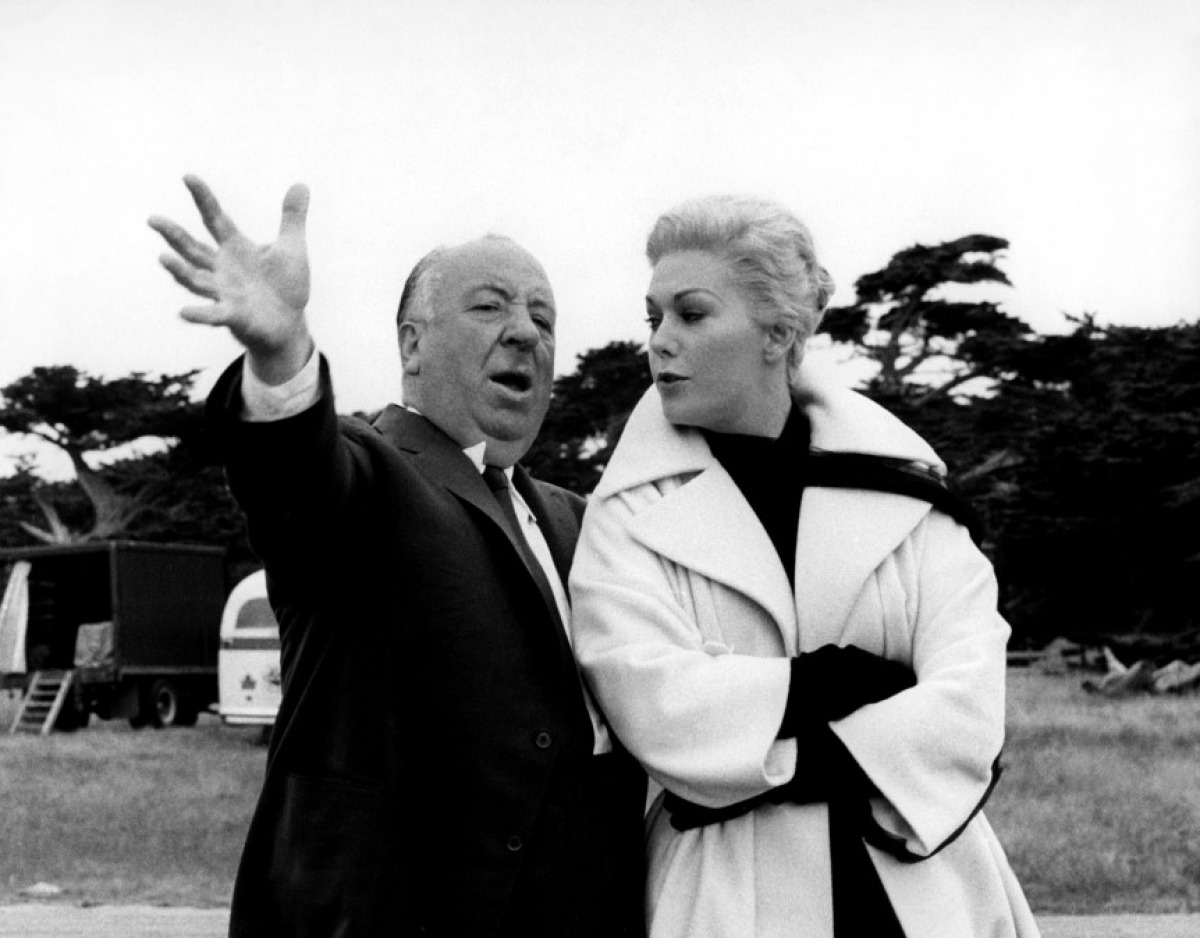
    “Do you believe that someone out of the past, someone dead, can enter and take possession of a living being?” Gavin Elster to Scottie in Alfred Hitchcock’s Vertigo

    Vertigo is, in my opinion, one of Hitchcock’s best films. On the surface it begins as a thriller, but it transitions into an exploration of loss, grief, and obsession. Watch it as one who is interested in Hitchcock in a cursory way and it is simply a very good film. Watch it as an obsessive Hitchcock fan and it becomes something deeper. A glimpse into his psyche? A manifesto? It is a study in obsession and creation and lies. It misleads and delights us simultaneously. Whatever it is, I am drawn to it for the same reason I am obsessed with Pre-Raphaelite art. There are layers and complexities here, nuances to tease out and ponder.

    Pre-Raphaelite works depend on their vibrant use of color, it’s one of the things that sets them apart from the formulaic Royal Academy approach that inspired the Pre-Raphaelite Brotherhood to rebel in the first place. While the earliest Pre-Raphaelite works are exquisite examples of jewel-like tones, it is often Dante Gabriel Rossetti’s use of the color green in his later works that I think of when I ponder my love of Pre-Raphaelite color.

    Dante Gabriel Rossetti   Proserpine   Google Art Project
    Proserpine, Dante Gabriel Rossetti

    As the title sequence in Vertigo unfolds, it sends a message that color is important in this film. We see a passive yet beautiful face, similar to the many images of Pre-Raphaelite women who appear lost in contemplation. The sequence focuses on her features, which summon Pre-Raphaelite comparisons to my mind. Rossetti lips. Burne-Jones eyes. The screen changes color repeatedly and it is a little off-putting. These are not soothing colors, but garish ones. Instead of lulling us into the movie-watching experience, the colors are jarring and a bit uncomfortable. We are then inundated with psychedelic spirals. On the one hand, they may represent the dizzying experience of vertigo, but they are also symbolic of the fact that we are about to be pulled into this vortex of a story as much as Scottie (Jimmy Stewart) is.

    Once you start paying attention to color in the film, you notice patterns. Yellow, green, and red appear everywhere.

    Let’s start with Midge, Scottie’s longtime friend. Played by Barbara Bel Geddes, she is the epitome of the girl-next-door. Quick-witted and funny, she covers her longing for Scottie with a breezy manner. Yet the moment he casually, and one could say cruelly, asks her if they were once engaged, we see a stiffening. “Aren’t you ever gonna get married?” Scottie asks her. ” We were engaged once, weren’t we?” Midge looks up, ever so slightly. Is she wondering how he could have ever forgotten such a thing? There’s something deep to Midge that the confines of the story never lets us fully explore.

    As we get deeper into the narrative we know she is safe for Scottie. She would never have caused the pain that he experienced due to his obsession with Madeleine. Perhaps it is this reason that Hitchcock chose to introduce her to us with sunny, friendly yellow. She not only wears yellow, but her apartment is yellow. The step stool she hands Scottie is yellow.
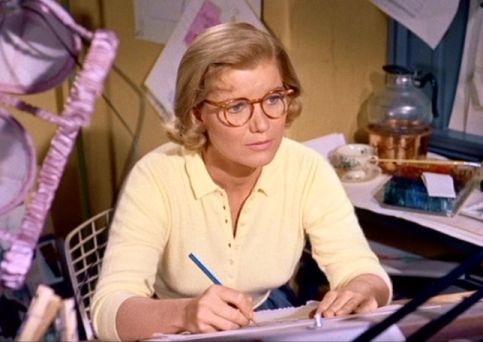
    Barbara Bel Geddes

    Scottie is associated with red; it often surrounds him on screen, in his furniture and clothes, and even the door of his apartment.
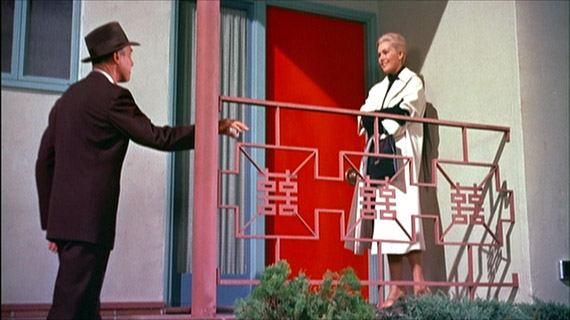
    Scottie is associated with red; it often surrounds him on screen, in his furniture and clothes, and even the door of his apartment.

    Scottie (James Stewart) and Madeleine (Kim Novak) outside of Scottie’s apartment.

    When we first see Madeleine, she is swathed in green just as beautifully as a Rossetti muse. Scottie came to the restaurant only as a favor to his old acquaintance Gavin Elster, who has asked Scottie to follow his wife. He’s concerned that she seems haunted. She loses time, wanders to strange places and goes into trance-like states. Scottie’s uninterested, at this point he’s just going through the motions.

    Until he sees her.

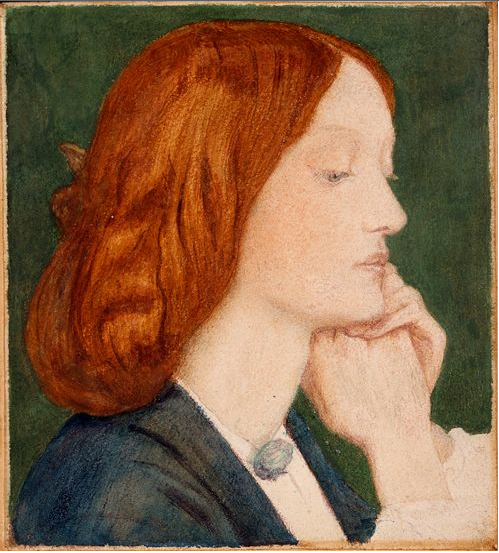
    Hitchcock reveals her to us from Scottie’s point of view… Madeleine, wrapped in striking green, leans elegantly and dramatically on the table. She silently crosses the room and we see her in profile, a study in emerald contrasted with the crimson walls. Dante Gabriel Rossetti and his muse Elizabeth Siddal come to mind. In a letter to artist Ford Madox Brown, Rossetti confided that when he first saw Siddal, he felt “his destiny was defined”. The same with Scottie. Madeleine’s beauty, her movement, her profile have all begun to draw him in, and there is no going back.

    Scottie is beguiled by Madeleine when he first sees her.
    Elizabeth Siddal
    Profile of Elizabeth Siddal drawn by Dante Gabriel Rossetti, who claimed his destiny was defined the moment he saw her.

    The following day, Scottie starts to follow her per her husband’s request. As we watch her lead him from place to place, it is obvious that he is intrigued. He never hears her thoughts or her voice, but he is captivated. He’s infatuated with her image. Madeleine is a silent muse, an object of Scottie’s male gaze. She’s still the green girl, surrounded by verdant Rossettian hues. We see it in her car and in the lighting of several scenes.

    As he follows her to a cemetery, there is something melancholy and mysterious about Madeleine. There is a sadness to her that is somehow beautiful, untouchable. At this point, Scottie possibly feels a mixture of curiosity and chivalry. He wants to understand her as well as save her.
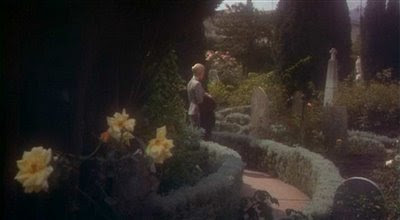
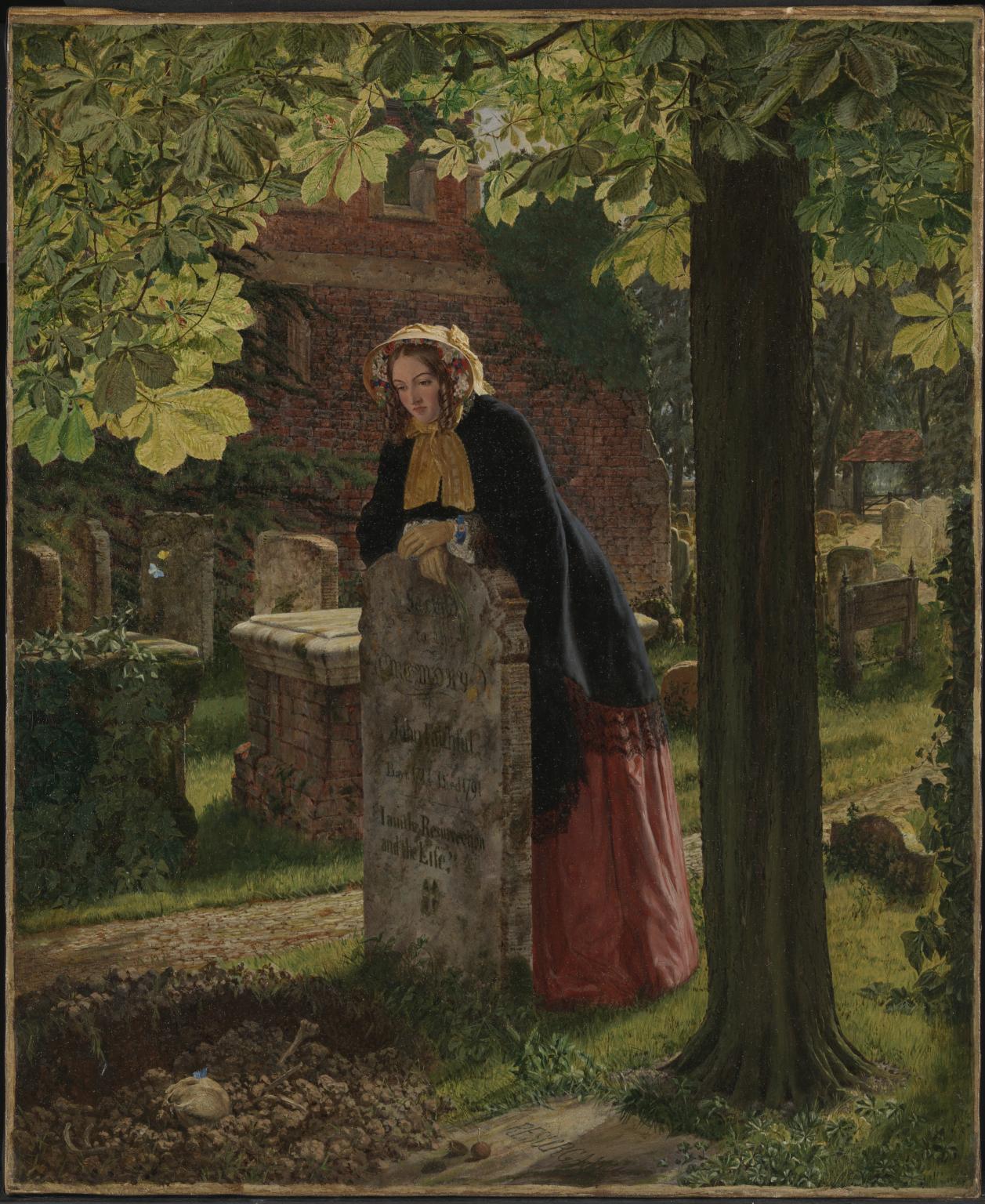
    This image has an empty alt attribute; its file name is Mission-Dolores-Graveyard.jpg
    This image has an empty alt attribute; its file name is canthesebones-246x300.jpg

    The Doubt: ‘Can these Dry Bones Live?’ exhibited 1855 Henry Alexander Bowler 1824-1903 Presented by H. Archer Bowler 1921 http://www.tate.org.uk/art/work/N03592

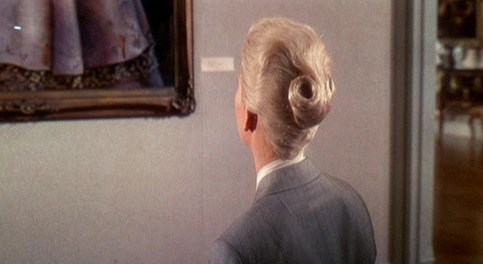
    He follows Madeleine to a museum. We don’t really see her face in this scene. It is all about him, his gaze, and his interpretation of her and the painting.

    At this point in the film, we don’t know that everything is a lie. We don’t need to see her face because what she feels about the painting isn’t genuine. She’s merely playing a part, with Gavin Elster as the artist in the background constructing a tableau. Once you watch Vertigo for the second time and understand the machinations involved, the museum scene takes on new significance. We follow Scottie’s eyes, we see the mental connections he makes as he is pulled further into the deception.

    The connections aren’t real, they are artfully planned.
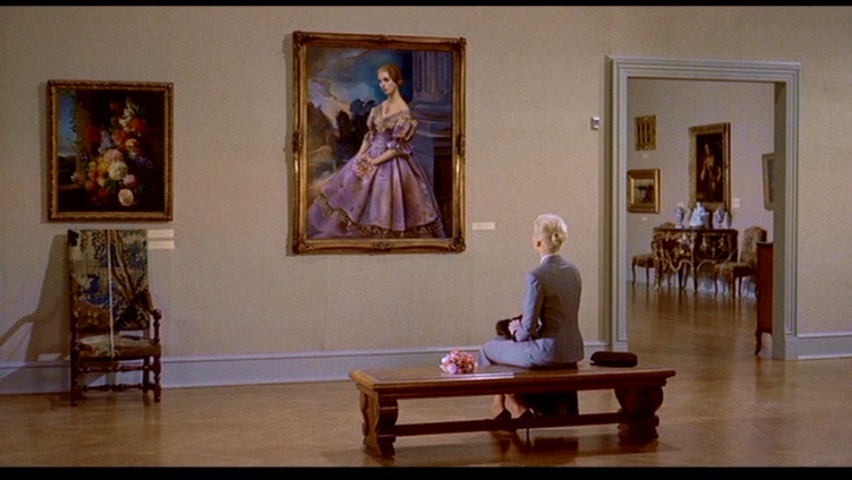
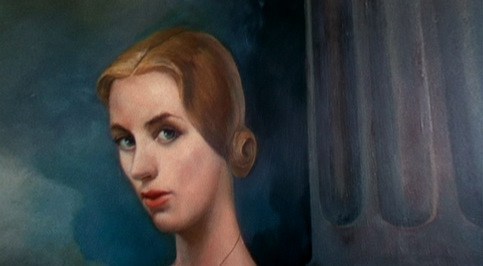
    Madeleine’s carefully pinned hair is just as important as the loose, wild tresses in Pre-Raphaelite imagery are. Her hair conveys a message; it displays her connection and obsession to the mysterious and long-dead Carlotta.

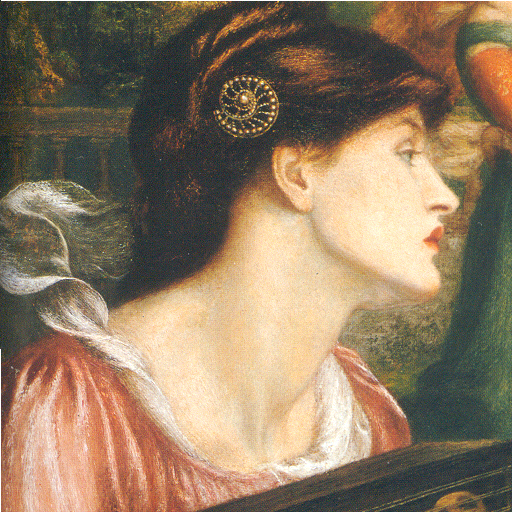
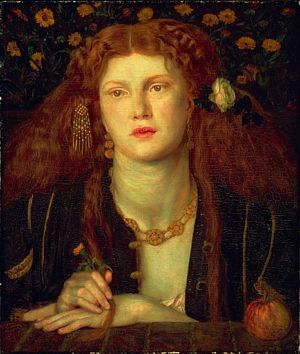
    The jewelry Carlotta wears in the painting is important as well. It will resurface later, but apart from its usefulness as a plot device, the jewelry in her portrait reminds me of Rossetti’s repeated use of jewelry in several of his works. The necklace in Fair Rosamund and Bocca Baciata, for example. Or his repeated use of the spiral hair pin.
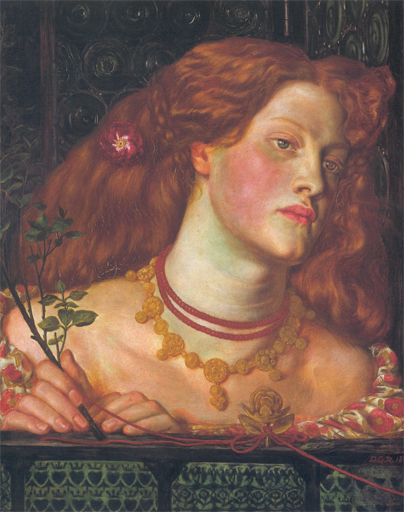
    Fair Rosamund, Dante Gabriel Rossetti
    ‘Bocca Baciata’, Dante Gabriel Rossetti
    This detail from The Bower Meadow shows the spiral hair pin seen in several Rossetti works.

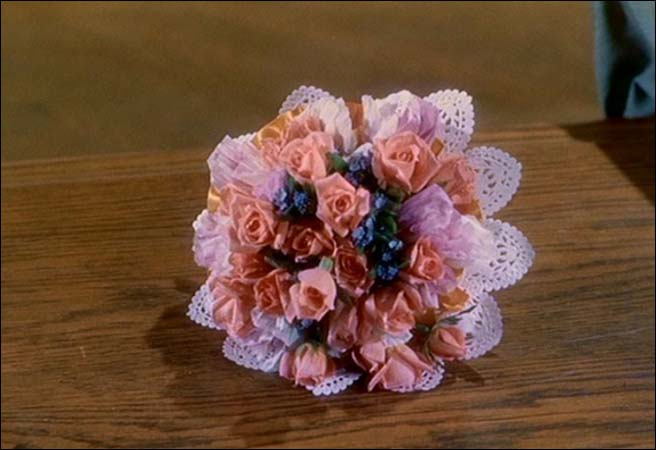
    Earlier, Madeleine has purchased a sweet little bouquet of flowers. Interestingly, she did not leave the flowers at Carlotta’s grave. When we see the flowers in the portrait, it can be assumed that the flowers didn’t need to be placed on the grave because Madeleine herself is Carlotta.
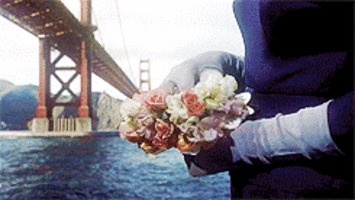
    Scottie turns to Midge to fill in the gaps of Carlotta’s story. When she introduces him to bookshop owner Pop Leibel, Scottie is told the sad tale of Carlotta, who went mad when her child was taken away by her lover. Carlotta committed suicide and apparently she is reaching across the branches of her family tree and possessing the unsuspecting Madeleine, her great-granddaughter. Carlotta is mad with grief, like a Pre-Raphaelite Ophelia.

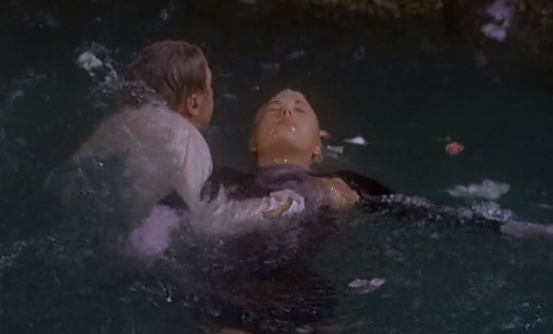
    Madeleine’s bouquet presents an interesting parallel to Ophelia, Hamlet’s tortured ingenue. Depicted repeatedly by Pre-Raphaelite artists, Ophelia’s sad tale is filled with flowers, water, and death. When a trance-like Madeleine visits Fort Point, she tears up the bouquet and sprinkles the remnants into the bay. The flowers float there, a visual reminder of Ophelia’s flowers floating along with her in her watery grave, her clothes ‘spread wide and mermaid-like’. Madeleine jumps into the bay in an apparent suicide attempt, making the Ophelia parallel complete.
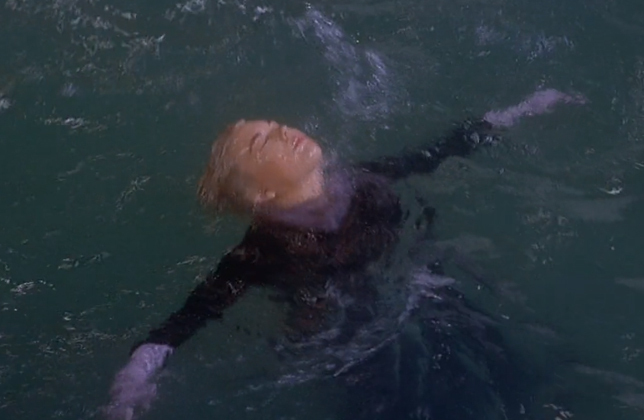
    Madeleine sprinkles her bouquet into the water.
    A Hitchcock-ian Ophelia
    Note the flowers floating around her during her suicide attempt, reminiscent of Millais’ depiction of Ophelia.
    Elizabeth Siddal as Ophelia, by John Everett Millais.

    Scottie carries her, wet and dripping, to his car. She is a rescued Ophelia, a Lady of Shalott saved from that whispered curse. The knight has, according to his code of chivalry, rescued her from drowning.
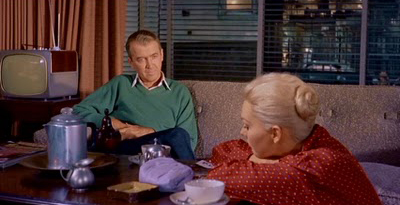
    Scottie brings her to his apartment and in this scene, they speak to each other for the first time. Notice that their colors are now swapped, Madeleine is in red while he is in green.
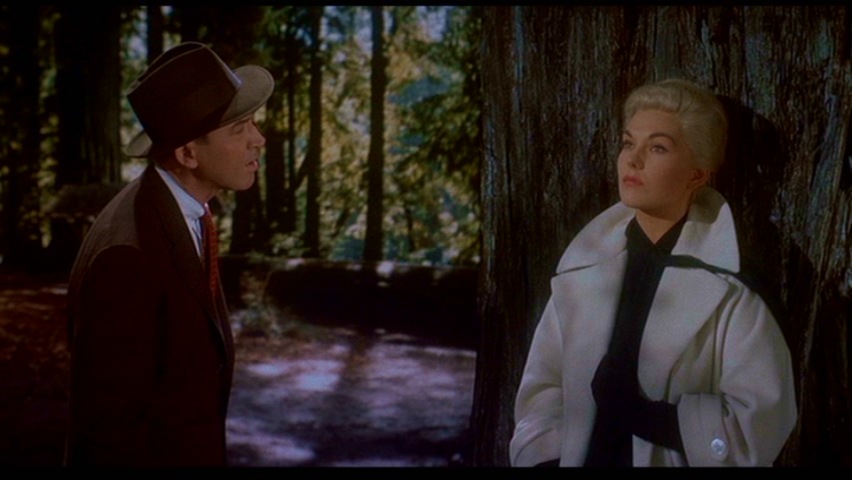
    “Their true name is Sequoia sempervirens, always green, everliving,” Scottie says of the trees when they visit Big Basin. “What are you thinking?” he asks. Madeleine answers, “Of all the people who’ve been born and who died while trees went on living. I don’t like it, knowing that I have to die.” Madeleine traces the rings of a felled tree. “Somewhere in here I was born…and there I died. It was only a moment for you, you took no notice.”

    When Madeleine invokes these things, she is crafting a spell and Scottie is falling further and further into her magic. She is more than an actress here as she leans against the massive trunk. She is a dryad among the trees, inviting and pulling him into madness that he does not yet understand.
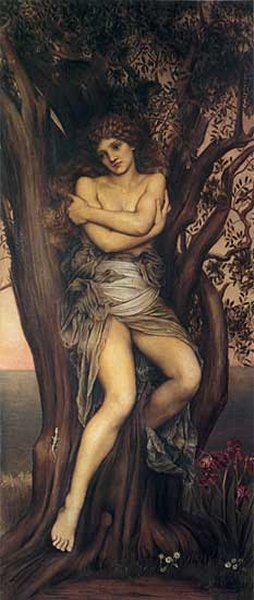
    The Dryad, Evelyn De Morgan

    The pair visit mission San Juan Bautista together. It is here that Madeleine runs up into the bell tower and plunges to her death while a helpless Scottie is unable to save her due to his fear of heights and vertigo. Her death devastates him, and suffering from what a doctor describes as acute melancholia and guilt, he spends time in a hospital to recover from the loss.

    Later, he becomes obsessed with the memory of Madeleine and constantly retraces their steps. He sees blondes everywhere and from a distance they resemble her, but upon closer examination the truth is delivered swiftly to him that she is gone, irreversibly gone.
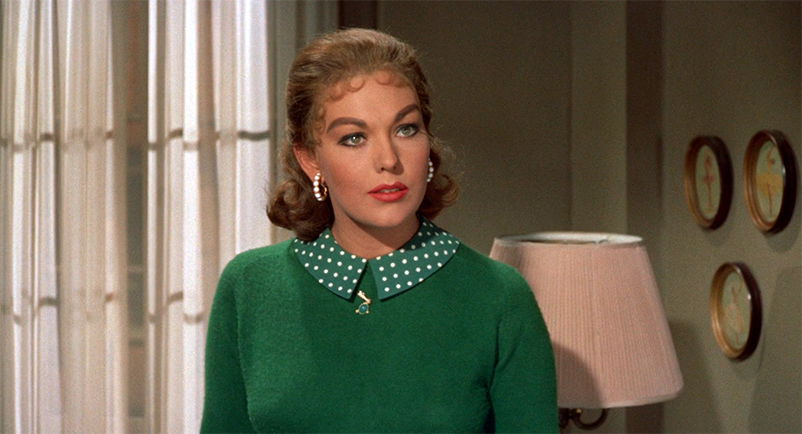
    Or is she? Outside a flower shop he sees Judy Barton, as unlike Madeleine in demeanor and class as she could be, save for her beautiful face. The vivacious redhead’s demeanor is a stunning contrast to Madeleine’s cool blonde comportment, yet her facial features are the same. The first time we see Judy, she is clothed in green. Brighter green than Madeleine, but green just the same.

    Then the truth is revealed to us. Scottie never met the true Madeleine, and Judy was playing her part all along. Yet Judy loves Scottie and decides to go on pretending in the hopes that he might love her too. Like an artist who can’t see his muse for who she really is, but only for what he can mold her into, Scottie is focused on Judy solely for the possibilities she embodies. He can use her to resurrect the woman he believes he lost; a woman who never existed. As Christina Rossetti said in her poem In An Artist’s Studio, “Not as she is, but as she fills his dream.”

    In An Artist’s Studio, Christina Rossetti

    One face looks out from all his canvasses,
    One selfsame figure sits or walks or leans;
    We found her hidden just behind those screens,
    That mirror gave back all her loveliness.
    A queen in opal or in ruby dress,
    A nameless girl in freshest summer greens,
    A saint, an angel;—?every canvass means
    The same one meaning, neither more nor less.
    He feeds upon her face by day and night,
    And she with true kind eyes looks back on him
    Fair as the moon and joyful as the light;
    Not wan with waiting, not with sorrow dim;
    Not as she is, but was when hope shone bright;
    Not as she is, but as she fills his dream.
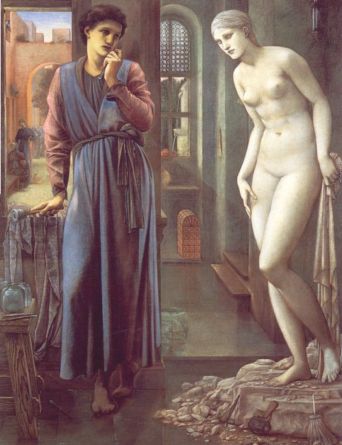
    Pygmalion and Galatea II: The Hand Refrains, Sir Edward Burne-Jones

    Scottie, in his attempt to recreate Madeleine, becomes a Pygmalion figure. The sculptor, dissatisfied with local women, created a statue so perfect and lovely that he prayed to Aphrodite to give him a wife as perfect as his creation. Aphrodite heard his prayers and brought his statue to life. The tale dates back to Ovid’s Metamorphoses and inspired George Bernard Shaw’s Pygmalion, which in turn was the basis for the musical My Fair Lady.

    Vertigo is perhaps a darker exploration of this Pygmalion-esque obsession. Yet if Scottie is Pygmalion, then perhaps Hitchcock is too. In film after film, he crafted and molded the “Hitchcock blonde” so intensely and frequently that now we associate her sleek, sophisticated coolness with his work as much as we associate Elizabeth Siddal and Jane Morris with the works of Dante Gabriel Rossetti. Women are central figures in both Hitchcock’s and Rossetti’s work. Paint the women out and there isn’t much left to explore.
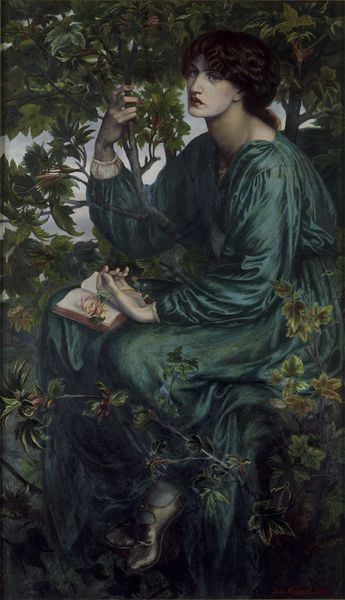
    ‘The Day Dream’, Dante Gabriel Rossetti (1880)

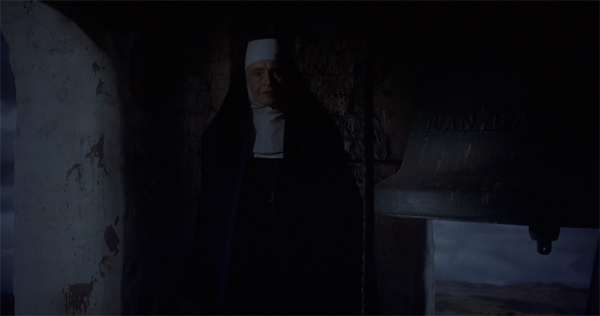
    When Scottie discovers the truth, he takes Madeleine/Judy back to the scene of the crime. In a frenzied scene, Hitchcock orchestrates a suspenseful trek up the staircase as Scottie confronts Judy. Ironically, once he realizes he has conquered his vertigo, Judy is startled by a nun entering the tower.
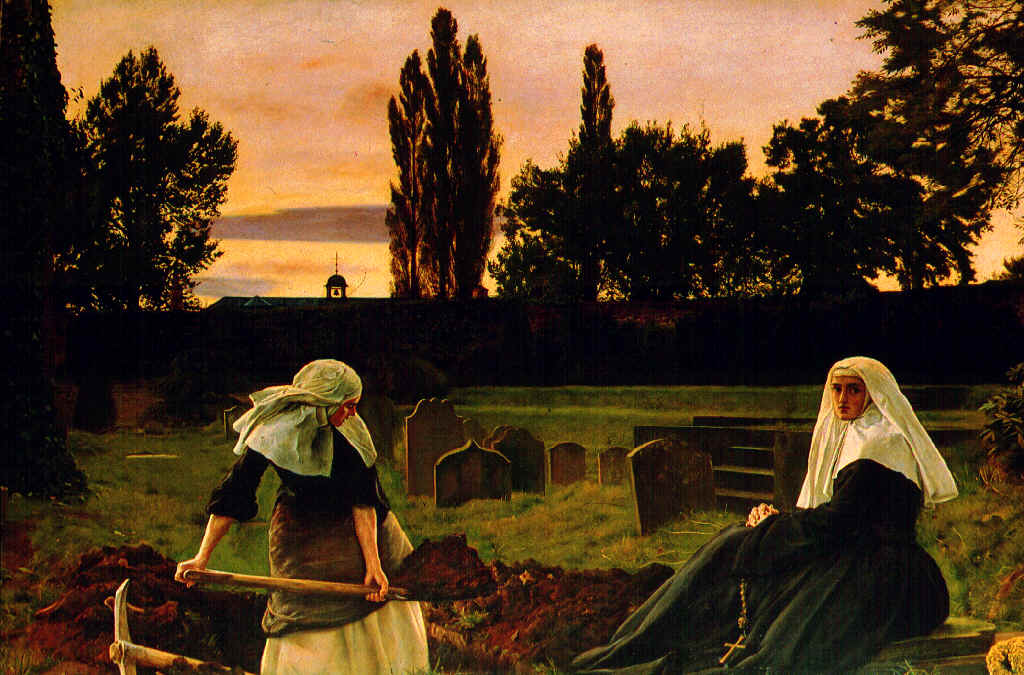
    ‘The Vale of Rest’, Sir John Everett Millais

    Judy falls to her death, the third plunging fatality to torment Scottie.

    We’ve reached the end, but it never feels like the end for me. Like a painting, the imagery and the narrative linger in my head. There’s so much to think about with Vertigo that I experience it in a backward fashion, starting with Judy’s death and following the thread of everything that led before.

    What is this film, exactly? It’s a doppelganger tale. It’s an exploration of fetishism and obsession. And it’s a good old-fashioned murder story. There are layers and symbolism to unpack and explore. The tragedy of it haunts me as much as any Ophelia painting. Hitchcock created a film that speaks to us in the same way as a Rossetti masterpiece. “I don’t want to die. There’s someone within me and she says I must die,” Madeleine cries to Scottie as he embraces her.

    This is pure Pre-Raphaelite melodrama to me and I love each and every second.

    More Adventures

  • Pre-Raphaelite Women

    by Stephanie Chatfield

    Pre-Raphaelite women were artists, poets, models, and creative partners whose influence shaped some of the most iconic works of Victorian art. From Elizabeth Siddal to Jane Morris, their lives reveal a world of passion, ambition, constraint, and remarkable talent. This page offers an in-depth look at their stories and lasting impact on Pre-Raphaelite art and culture.

    Christina rossetti

    Christina Rossetti

    Sister of Pre-Raphaelite artist Dante Gabriel Rossetti and critic William Michael Rossetti. A talented poet in her own right, Christina can be seen in several early works of her brother’s, namely The Girlhood of the Virgin Mary and Ecce Ancilla Domini. Read more.

    Jane Morris

    Jane Morris

    Jane Morris was a poor, working-class girl when she was spotted in the audience of an Oxford theatre by Dante Gabriel Rossetti and Ned Burne-Jones. She may have stolen Rossetti’s heart, but it was his friend William Morris she married. Their love triangle is one of the most famous in art history. Read more.

    Fanny Cornforth

    Fanny Cornforth

    Of all the models involved with the Pre-Raphaelites, Fanny suffered the most from classism and sheer disdain. Rossetti may have treasured her friendship, but many people in his life strove to create distance between them. Fanny was difficult to dominate, though, and resolutely stood her ground. Read more.

    georgiana Burne-Jones

    Georgiana Burne-Jones

    Georgiana was the daughter of a Methodist minister and she and Edward “Ned” Burne-Jones were childhood sweethearts. She not only appears in many of his works, but her family is a veritable who’s who of Victorian culture. Read more.

    Annie Miller

    Annie Miller

    Artist William Holman Hunt discovered Annie Miller living in squalor and took on a Pygmalion-like role to help shape her into a respectable Victorian lady. Their love story did not have a happy ending, however. Read more.

    Alexa Wilding

    Alexa Wilding

    Alexa’s beautiful face graces much of Dante Gabriel Rossetti’s later work. Struck by her beauty, Rossetti approached Alice “Alexa” Wilding as she walked home from her dressmaking job. She appeared at a fortuitous time for the artist, as his paintings of Fanny Cornforth were no longer selling as they once had. Read more.

    Effie Millais

    Effie Millais

    When young Euphemia “Effie” Gray married art critic John Ruskin, she could not have predicted what a strange marriage theirs would be. Ruskin became an important friend in the Pre-Raphaelite’s corner, especially Millais. Effie and Millais fell in love and married after Ruskin and Effie’s union was annulled after six years on grounds of non-consumation. Read more.

    Evelyn de Morgan

    Evelyn De Morgan

    Evelyn was encouraged to pursue art at a young age by her uncle, artist John Roddam Spencer Stanhope. Much of her work reflects her dedication to pacifism, painted during both the Boer War and World War I. She married ceramicist William De Morgan and together they devoted their lives to the creation of art. Read more.

    Maria Zambaco

    Maria Zambaco

    Born into a wealthy Greek family that had immigrated to England, Maria studied under sculptor Auguste Rodin. She appears in several Pre-Raphaelite works by Rossetti and Burne-Jones, who became her lover. The end of their affair was tumultuous and painful for all, especially Burne-Jones’ wife Georgiana. Read more.

    marie Spartali stillman

    Marie Spartali Stillman

    Cousin to Maria Zambaco, Marie studied art under Ford Madox Brown. Her beauty is apparent in works by Rossetti and Burne-Jones, but her talent shines in the exquisite Pre-Raphaelite painting she herself created. Read more.

    Emma Madox brown

    Emma Madox Brown

    Emma Hill started modeling for Ford Madox Brown around 1848—she’s actually the woman portrayed as the wife in The Last of England. Over time, their relationship grew more personal, and she became his mistress…Read more.

    Boyce Bird Of God 1861 0c

    Joanna Boyce

    Joanna Mary Boyce was a painter closely associated with the PRB, in fact, she was the sister of Pre-Rapahelite artist and watercolourist George Price Boyce Read more.

    1854lizzie

    Elizabeth Siddal

    Lizzie helped shape the concept of a “Pre-Raphaelite look” and is recognizable in many important works, the most famous being Ophelia by Sir John Everett Millais. In addition to modeling, she was one of the first female Pre-Raphaelite artists. Read more.

    More about the Pre-Raphaelites

  • The Diaries of William Allingham

    The Diaries of William Allingham

    by Stephanie Chatfield

    If you’re serious about studying the Victorian era, diaries and letters are essential. Sometimes I feel like a 21st-century eavesdropper, eagerly devouring personal journals and private correspondence whenever I can.

    Through these firsthand accounts, the past doesn’t always spring vividly to life, but it does pierce the mist with greater clarity.

    The diaries of Irish poet William Allingham are a perfect example of this subtle magic.

    A true lover of the written word, Allingham sought out friendships with many of the 19th century’s most creative minds. His diary offers a rare, intimate glimpse into the lives of the Pre-Raphaelite Brotherhood, Tennyson, Julia Margaret Cameron, and others.

    Covering the years from 1824 to 1889, his firsthand account is both captivating and invaluable. While his longer passages draw you in with their richness, it’s often the briefest entries that are the most poignant: “28 October: Evening. Moonlight. Molière.”

    Allinghamreading
    William Allingham reading. Painted by his wife, artist Helen Allingham.

    Allingham was an avid reader, and the frequent references to books throughout his diaries are of particular interest to me. I’ve compiled a list of the titles he mentions and added it to the end of this post.

    A Glimpse into the Pre-Raphaelites

    I first became interested in Allingham’s diaries when I launched LizzieSiddal.com, a website dedicated to the Pre-Raphaelite model and painter Elizabeth Siddal. Siddal was one of the earliest faces of the Pre-Raphaelite movement, immortalized as Millais’ drowned Ophelia and muse to Dante Gabriel Rossetti, whom she later married.

    Elizabeth Siddal at Easel
    Elizabeth Siddal at Easel

    In some versions of Siddal’s discovery by the Brotherhood, it was Allingham who introduced her to the young artists. Smitten with one of her co-workers, he supposedly mentioned her to Walter Deverell when Deverell was searching for a model for his painting Twelfth Night.

    Other accounts, including William Holman Hunt’s Pre-Raphaelitism and the Pre-Raphaelite Brotherhood, claim that Deverell discovered her himself while visiting the millinery shop with his mother.

    Curious to confirm the story, I turned to Allingham’s diary, only to be disappointed. Although he mentions both Siddal and Rossetti, there’s no suggestion that he played a role in their introduction. Does that mean the story is untrue? I can’t confirm it, but neither can I dismiss it outright. It remains unsubstantiated, and after all, Allingham never documents meeting or courting his own wife either. Helen Allingham, an artist in her own right, simply appears in the diaries after their marriage.

    It seems that both accounts of Siddal’s discovery have come to us through hearsay. The version involving Allingham can be traced to Violet Hunt’s 1932 book Wife of Rossetti, where, according to Jan Marsh in Pre-Raphaelite Sisterhood, Hunt claimed to have heard the story from Allingham’s widow after the poet’s death. The Deverell version comes from Holman Hunt’s own memoir. Most likely, the truth lies somewhere between the two. (I can’t resist adding that Violet Hunt’s biography is far from reliable! It’s gossipy, full of unverified anecdotes, and prone to imaginative flourishes. If you’re only going to read one book about Siddal, let it not be that one.)

    I didn’t find the answer to my original question in Allingham’s diaries, but I found something far richer.

    With a keen and careful eye, he captures the men of letters he so admired, noting even the smallest details.

    Slices of Life

    But he doesn’t limit himself to the literary elite. He also records glimpses of the less fortunate…like a young girl sentenced to seven years’ transportation for stealing a purse: “She is removed shrieking violently. It seems a severe sentence.” Or his visit to a poorhouse, where he meets Tom Read, “a crazy man with small sharp black eyes; sometimes keeps a piece of iron on his head to do his brain good; plays on a fiddle, the first and second strings only packthread.”Allingham promises to bring him proper violin strings.

    What he chose to record reflects his deep love of literature and his enduring admiration for writers. He didn’t seem interested in meticulously documenting every conversation, only the ones that struck him, the ones he wanted to preserve. Even when he disagreed, he presented his friends’ differing opinions with respect. His physical descriptions are vivid and memorable too: “Ouida (Louise de la Ramee) in green silk, sinister clever face, hair down, small hands and feet, voice like a carving knife.” Or his sharp portrait of Nathaniel Hawthorne: “features elegant though American.”

    Coventry Patmore
    Left: Drawing of Coventry Patmore, 1855, by John Brett. Right: Sir John Everett Millais’ painting The Woodsman’s Daughter, based on Patmore’s poem

    An Eye for Detail

    In 1849, just a year after the formation of the Pre-Raphaelite Brotherhood, Allingham made the acquaintance of Coventry Patmore. During a visit to Patmore’s home, he noticed a cast of a statuette by the Pre-Raphaelite sculptor Thomas Woolner. What stands out is the level of detail in Allingham’s account, not just of the sculpture itself, but of every aspect of the visit. Throughout his journals, Allingham captures the great writers he meets within their own surroundings, carefully describing their homes, the conversations they share, and even the books he happens to spot on their tables. It’s this attention to minutiae that makes his diaries so captivating.

    Two small sitting-rooms with folding door between: front room has engraved portraits of Wordsworth and Faraday over the mantelpiece (‘the two greatest men of our time’), a round table with ten or a dozen books, and plaster cast of statuette of Puck — just alighted on a mushroom and about to push with his toe a bewildered frog  which a snake is on the point of snapping up. You can see that he saves the frog out of fun mostly, and to tease the snake.  He is a sturdy elf, plainly, yet not humanly, masculine.  A very original bit of work, by ‘a young artist named Woolner’. In the back room P’s writing-table at the window, with a few bookshelves beside it.  I notice Coleridge’s ‘Table Talk‘ and ‘Aids to Reflection’, and  Keats’s ‘Remains’. Them we started on a walk northward. Patmore thoroughly agrees with me that artistic form is necessary to poetry.

    Puck, sculpture by Thomas Woolner
    Puck 1845-7 Thomas Woolner 1825-1892 Presented by the Patrons of British Art through the Friends of the Tate Gallery 1991 http://www.tate.org.uk/art/work/T05857

    A visit to Dante Gabriel Rossetti in 1864 gives us a now-famous glimpse of the model Fanny Cornforth, whose dialect made her the subject of amusement, no doubt to her embarrassment.

    “Down to Chelsea and find D.G. Rossetti painting Venus Verticorida.  I stay for dinner and we talk about the old P.R.Bs.  Enter Fanny, who says something about W.B. Scott which amuses us.  Scott was a dark hairy man, but after an illness has reappeared quite bald.  Fanny exclaimed, “O my, Mr Scott is changed!  He ain’t got a hye-brow or a hye-lash — not a ‘air on his ‘ead!’  Rossetti laughed immoderately at this, so that poor Fanny, good-humoured as she is, pouted at last–“Well, I know I don’t say it right,” and I hushed him up.”

    Venus Verticordia painting
    ‘Venus Verticordia’, Dante Gabriel Rossetti. This is the painting DGR was working on during Allingham’s visit. The model for this piece was Alexa Wilding, who appears in may Rossetti works, including The Blessed Damozel.

    He visits the Red House to see William Morris and his “queenly wife crowned with her own black hair.” Allingham describes Morris with clear affection: “I like Morris very much. He is plain-spoken and emphatic, often boisterously, without an atom of irritating manner.” On a visit to Edward Burne-Jones’ studio, Allingham offers a vivid glimpse of works in progress: “Saturday, 28 October. 41 Kensington Square — two studios. ‘Zephyr carrying Psyche’ — delightful — precipice, green valley, Love’s curly little castle below. Designs of ‘St. George and Dragon.’ Drawings of Heads. Circe (a-doing), she stretching her arm across.”

    Burne Jones Zephyr
    ‘Zephyr and Psyche’, Sir Edward Burne-Jones (1865)

    Two accounts of the photographer Julia Margaret Cameron are quite humorous. In the first, Tennyson is clearly teasing her, while in the second, we catch a glimpse of the great poet’s reaction to JMC’s photograph of him, as well as her exasperation with those who refuse to be photographed.

    Tennyson and Julia Margaret Cameron
    Left: Alfred, Lord Tennyson photograph by Julia Margaret Cameron.
    Right: Victorian photographer Julia Margaret Cameron

    (November 1865)  Tea:  enter Mrs Cameron (in funny red open-work shawl) with two of her boys. T. appears, and Mrs C. shows a small firework toy called ‘Pharaoh’s Serpents’, a kind of pastile, which, when lighted, twists about in a worm-like shape.  Mrs C. said the were poisonous and forbad us all to touch. T. in defiance put out his hand.

    ‘Don’t touch ’em!’ shrieked Mrs C ‘You shan’t, Alfred!’ But Alfred did.  ‘Wash your hands then!’  But Alfred wouldn’t, and rubbed his moustache instead, enjoying Mrs C.’s agonies.  Then she said to him: ‘Will you come tomorrow and be photographed?’  He, very emphatically, ‘No.’

    (June 1867) Down train comes in Mrs Cameron, queenly in a carriage by herself surrounded by photographs.  We go to Lymington together, she talking all the time, ‘I want to do a large phtograph of Tennyson, and he objects!  Says I make bags under his eyes — and Carlyle refuses to give me a sitting, he says it’s a kind of Inferno!  The greatest men of the age’ (whith strong emphasis), ‘Sir John Herschel, Henry Taylor, Watts, say I have immortalized them — and these other men object!!  What is one to do — Hm?

    This is a kind of interrogative interjection she often uses, but seldom waits for a reply.”

    William morris, ned Burne-jones
    Burne-Jones and William Morris (photograph by Frederick Hollyer)

    “Saturday, 18 August.  Ned sketches.  I read aloud Robin Hood and the Monk… Ned does not paint down here (It’s his holiday), and only makes a few pencil sketches.  He occupies himself, when in the mood, with designs for the Big Book of Stories in Verse by Morris, and has done several from Cupid and Psyche; also pilgrims going to Rome and others.  He founds his style in these on old Woodcuts, especially those in Hypnerotomachia, of which he has a fine copy.  His work in general, and that of Morris too, might perhaps be called a kind of New Renaissance. “

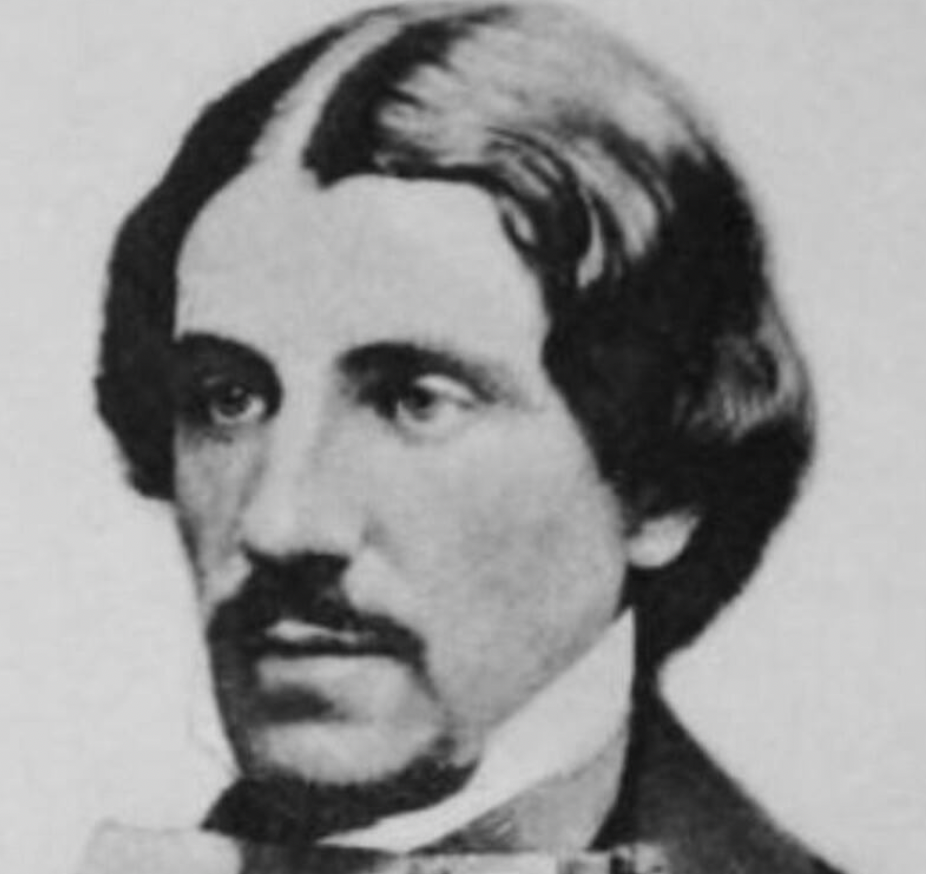
    Description of Dante Gabriel Rossetti

    Dante Gabriel Rossetti
    Dante Gabriel Rossetti

    When Dante Gabriel Rossetti came to visit, Allingham made a note in his diary, reminding himself to “Use him nobly while your guest” and to read Rossetti’s Early Italian Poets. At one point during his stay, Allingham observes that DGR didn’t make an effort to leave the sofa all day, so engrossed was he in reading The Mill on the Floss. I love how Allingham describes him so vividly, capturing both his physical presence and his artistic tastes.

    “R. walks very characteristically, with a peculiar lounging gait, often trailing the point of his umbrella on the ground, but still obstinately pushing on and making way, he humming the while with closed teeth, in the intervals of talk, not a tune or anything like one but what sounds like a sotto voce note of defiance to the Universe. Then suddenly he will fling himself down somewhere and refuse to stir an inch further.  His favourite attitude–on his back, one knee raised, hands behind his head.  On a sofa he often, too, curls himself up like a cat.

    He very seldom takes particular notice of anything as he goes, and cares nothing about natural history, or science in any form or degree.  It is plain that the the simple, the natural, the naive are merely insipid in his mouth; he must have strong savours, in art, in literature and in life.  Colours, forms, sensations are required to be pungent, mordant.  In poetry he desires spasmodic passion, and emphatic, partly archaic, diction.  He cannot endure Wordsworth.  He sees nothing in Lovelace’s “Tell me not, Sweet, I am unkind”.  In foreign poetry, he is drawn to Dante by inheritance (Milton, by the way, he dislikes); in France he is interested by Villon and some others of the old lyric writers, in Germany by nobody.  To Greek literature he seems to owe nothing, nor to Greek art, directly.  In Latin poetry he has turned to one or two things of Catullus for sake of the subjects.  English imaginative literature — Poems and Tales, here lies his pabulum:  Shakespeare, the old Ballads, Blake, Keats, Shelley, Browning, Mrs Browning, Tennyson, Poe being first favourites, and now Swinburne.  Wuthering Heights is a Koh-i-noor among novels, Sidonia the Sorceress ‘a stunner’.  Any writing that with the least competency assumes an imaginative form, or any criticism on the like, attracts his attention more or less; and he has discovered in obscurity, and in some cases helped to rescue from it, at least in his own circle, various unlucky books; those, for example, of Ebenezer Jones (Studies of Sensation and Event) and Wells, author of Joseph and His Brethren and Stories of Nature.  About these and other matters Rossetti is chivalrously bold in announcing and defending his opinions, and he has the valuable quality of knowing what he likes and sticking to it.  In Painting the Early Italians with their quaintness and strong rich colouring have magnetised him.  In Sculpture he only cares for picturesque and grotesque qualities, and of Architecture as such takes, I think, no notice at all.”

    A Passionate Bibliophile

    When he expresses his deep passion for the written word, I find an undeniable connection. It’s not necessarily about agreeing or disagreeing on a particular work, but about instantly recognizing that shared passion; a passion I too possess. (I’m sure many of you can relate to that). In 1858, he wrote these thoughts on the work of Robert Browning:

    “Too often want a solid basis for R.B.’s brilliant and astounding cleverness.  A Blot in the ‘Scutcheon is solid. How try to account for B.’s twists and turns?  I cannot. He has been and still is very dear to me.  But I can no longer commit myself to his hands in faith and trust.  Neither can I allow the faintest shadow of a suspicion to dwell in my mind that his genius may have a leaven of quackery. Yet, alas! he is not solid–which is a very different thing from prosaic.  A Midsummer Night’s Dream is as solid as anything in literature; has imaginative coherency and consistency in perfection.  Looking at forms of poetic expression, there is not a single utterance in Shakespeare, or of Dante as far as I know, enigmatic in the same sense as so many of Browning’s are.  If you suspect, and sometimes find out, that riddles presented to you with Sphinxian solemnity have no answers that really fit them, your curiosity is apt to fall towards freezing point, if not below it.  Yet I always end by striking my breast in penitential mood and crying out, ‘O rich mind! wonderful Poet! strange great man!’

    One of Allingham’s most consistent friendships was with Thomas Carlyle.  He’s mentioned throughout the diaries repeatedly.  They frequently discussed literature

    In 1871:

    “8 November, 1871: With Carlyle. Old Saints.  Shakespeare: C. said with emphasis, “The longer I live, the higher I rate that much-belauded man.” He thought that Shakespeare was much impressed with Christianity; to which I demurred.  He repeated ‘The cloud-capt Towers’, etc., dwelling once more on We are such stuff as dreams are made of, and out little life, is rounded with a sleep.’–He quoted Richter–‘These words created whole volumes within me,” and mused, saying the words again to himself, ‘such stuff as dreams are made of’.
    To my mind, I confess this fine dramatic passage seems of no very particular value when separated from its context.
    We agree about Scott as a poet, and, on the whole, about Byron–Moore, too.
    Spoke of Gray–the Elegy, Letters from the Lakes, and passed to Goldsmith.  At no time did C. show himself so happy and harmonious as when talking on some great literary subject with nothing in it to raise his pugnacity.  The books and writers who charmed his youth–to return to these was to sail into sheltered waters.
    C. said ‘Writing is an art.  After I had been at it some time I began to perceive more and more clearly that it is an art.’ “

    1874:

    “Of Browning’s Balaustion, C. said ‘I read it all twice through, and found out the meaning of it.  Browning most ingeniously twists up the English language into riddles–“There! there is some meaning in this–can you make it out?” I wish he had taken to prose.  Browning has far more ideas than Tennyson, but is not so truthful.  Tennyson means what he says, poor fellow! Browning has a meaning in his twisted sentences, but he does not  really go into anything, or believe much about it.  He accepts conventional values. “

    While reading the diary, I made note of books mentioned by Allingham in order to compile a reading list:

    • The Waverley Novels
    • He records which Waverley novels impressed him at the time: Guy ManneringThe Antiquary, Ivanhoe, Kenilworth, The Talisman, then goes on to say in scenes in The Fortunes of Nigel, Quentin Durward, The Fair Maid of Perth, The Pirate, and The Monastery “as vivid as any real experience”.
    • The Lady of the Lake and Marmion, both by Sir Walter Scott
    • Laurie Todd, or the Settlers in the Wood John Galt
    • Brambletye House: Or Cavaliers and Roundheads by Horace Smith
    • The Essays of Elia, Charles Lamb
    • Poems of Percy Bysshe Shelley
    • Lamb’s Tales from Shakespeare, Charles Lamb
    • Johnson’s ‘Poets’
    • Hierarchy of Blessed Angels, Thomas Heywood
    • Table Talk and Aids to Reflection, both by Coleridge
    • Life, Letters, and Literary Remains of John Keats
    • Week on the Concord and Merrimac Rivers, Thoreau
    • The Raven, Poe
    • A footnote by Allingham’s wife says that in 1850-53 he read Homer, Plato, Plutarch, Meredith’s Poems, Coleridge, Emerson, Gibbon, Dante, Swedenborg, Byron, Barnes, Bacon’s Essays, she notes, “he read and walked every evening.”
    • Mr Sludge, “The Medium”, Browning
    • Newman’s Apologia
    • Ursula Mirouet, Honore de Balzac
    • Tennyson’s Maud
    • Robin Hood and the Monk
    • Folio of Virgil w/plates (read with Burne-Jones during his stay with W.A.)
    • Raleigh’s History of the World (also looked at with Burne-Jones)
    • As You Like It, Shakespeare (Diary entry: “4 May 1867 Sit under Big Oak reading As You Like It– and this might be Jacque’s very brook in Arden.”)
    • Life and Death of Jason, William Morris (W.A. described it as ‘admirable’.)
    • May-Day and Other Pieces, given to W.A. from the author,  Emerson
    • The Mill on the Floss, George Eliot
    • The Ring and the Book, Browning
    • Frederick the Great, written by his friend Thomas Carlyle. (W.A. referred to it as the ‘reductio ad absurdum’ of Carlyleism and said “open it where you, the page is alive.”)
    • Works of Francis Bacon, edited by Spedding
    • Jane Eyre
    • Vanity Fair

    More about the Pre-Raphaelites

  • Pre-Raphaelite: Not a Look, a Movement

    Pre-Raphaelite: Not a Look, a Movement

    Somewhere along the way, “Pre-Raphaelite” became shorthand for a look: abundant hair, pale skin, some moody greenery. A woman who seems to have wandered out of a medieval daydream and into your Pinterest feed.

    I understand the appeal, but when we reduce the Pre-Raphaelites to solely an aesthetic, or a vibe, we miss the thing that made their work so unnervingly alive.

    The Pre-Raphaelites weren’t a hairstyle. They were a worldview.

    They treated nature not as backdrop but as a living language. A river wasn’t scenery; it was fate. A flower wasn’t decoration; it was a message. The world itself seemed to press in with meaning.

    And they treated stories the same way.

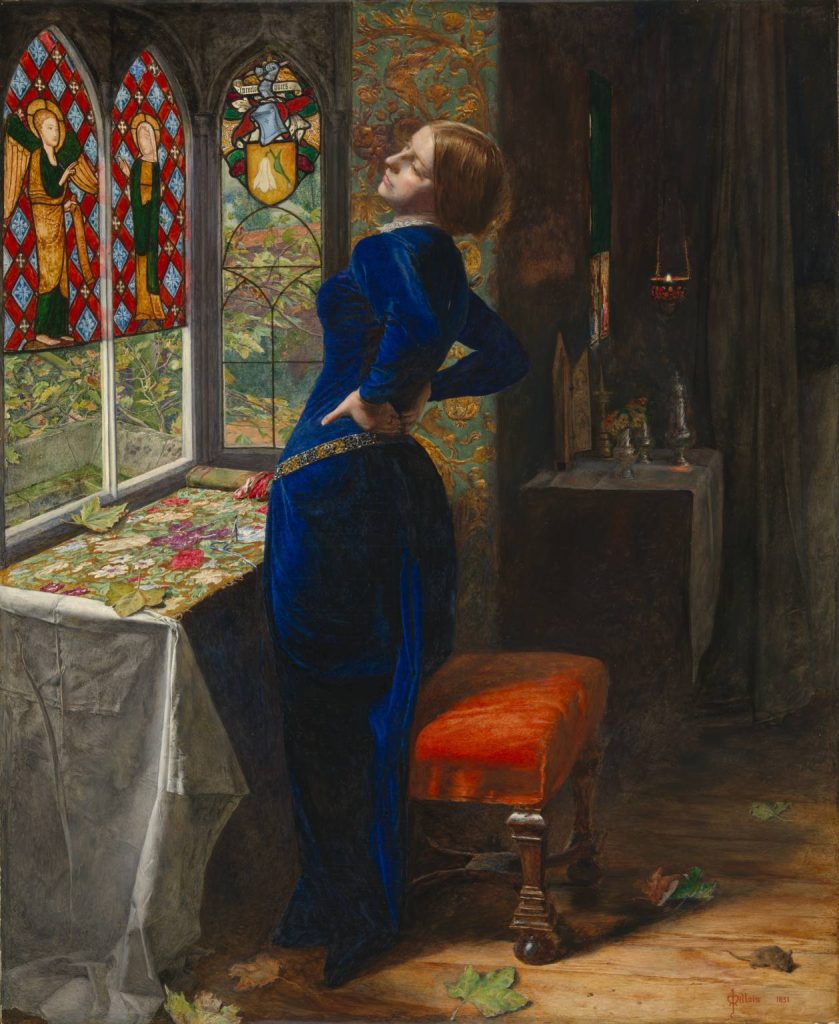
    Mariana, Sir John Everett Millais
    Mariana, Sir John Everett Millais

    Myths, legends, Shakespeare, Arthurian romance… these weren’t merely escapism. They were serious material, charged with warnings and longings. Their paintings don’t merely “illustrate” a tale; they interrogate it. Who is being sanctified? Or being punished? Who is being turned into a symbol instead of allowed to be a person?

    That last question matters more than ever, because the visual internet trades in symbols. A tragic girl. The beautiful woman framed as a mood, “Opheliacore,” the languid gaze, the hair like a halo. The Pre-Raphaelites gave us many of those visual templates.

    They also, if we’re honest, helped build the cage: the idea that beauty is virtue, that suffering is poetic, that women look best when they are luminous and still.

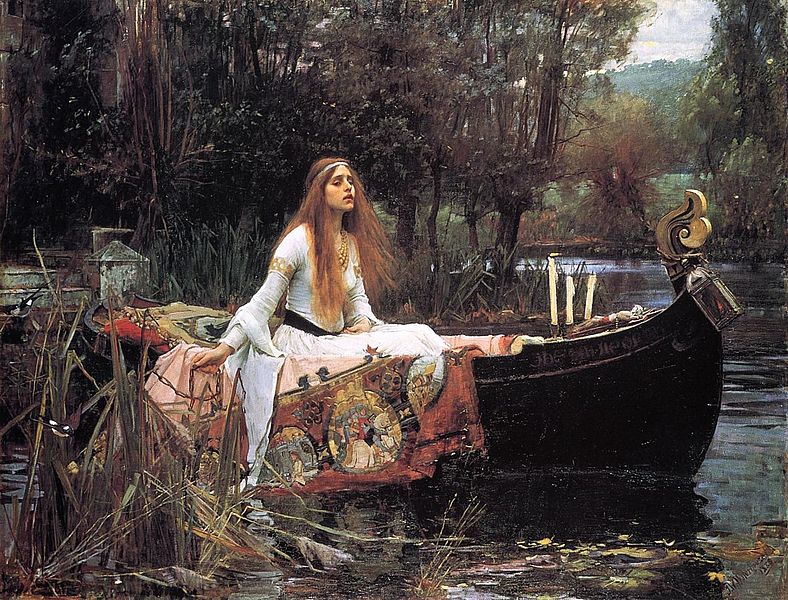
    Just look at Millais’ Ophelia, or Waterhouse’s The Lady of Shalott. Women suspended in a moment of aestheticized tragedy, turned into icons of doomed grace. (See Pre-Raphaelite Women at The Victorian Web and the Pre-Raphaelite Collection at The Tate.)

    The Lady of Shalott, John William Waterhouse
    The Lady of Shalott, John William Waterhouse

    Which is why we shouldn’t throw the aesthetic away. We should wake it up.

    If we love Pre-Raphaelite beauty (and of course we do!) we can love it with our eyes open, looking past the hair and ask what the painting is teaching you about desire, virtue, power, punishment, and the cost of being seen. Let the art be both gorgeous and complicated. Roses with thorns.

    Because that’s the real inheritance.

    Not the curls.

    The way of seeing.